Let’s Get Real on the Deficit

June 22, 2011

New York Times Pulitzer Prize-winning columnist David Leonhardt today properly calls “bull$hit” on the hot air being blown out of Washington and among political activists about the reasons behind the federal budget deficit and right ways to address it.

Eventually, the country will have to confront the deficit we have, rather than the deficit we imagine. The one we imagine is a deficit caused by waste, fraud, abuse, foreign aid, oil industry subsidies and vague out-of-control spending. The one we have is caused by the world’s highest health costs (by far), the world’s largest military (by far), a Social Security program built when most people died by 70 — and to pay for it all, the lowest tax rates in decades.

To put it in budgetary terms, the deficit we imagine comes largely from discretionary spending. The one we have comes partly from discretionary spending but mostly from everything else: tax rates, Medicare, Medicaid and Social Security.

The doctrinaire, devoid of a solid theoretical or historical foundation, abhorrence of any increase in taxes or reduction of any tax deduction or shelter  by Republicans has to change.  Clinton’s increase in taxes in the ’90s didn’t snuff out the economy.  Bush II’s tax cuts didn’t fuel it.

While I don’t think that Simpson-Bowles is perfect or nearly enough, it’s a start.  Leaders (as opposed to merely elected officials or politicians–there’s a difference) need to step forward and make this happen.

And don’t get me started on how insane it is to not have approved an increase in the federal debt ceiling.  Play with fire and get burned.  Making a mistake on that topic and we will be paying the price for generations.


For A Single Set of Rules For Baseball

June 19, 2011

We need to define exactly what “baseball” is.  Do pitchers need to bat or don’t they?  One way or the other.  Having two sets of rules makes as much sense as…nothing.  There are no circumstances in which having two sets of rules for a single sport makes any sense.

Imagine a world in which hockey games in the Eastern Conference get six skaters plus a goalie–except when they’re playing a Western Conference team on the road in which they would revert back to the “traditional” five skaters plus a goalie.  It would create chaos–just as it’s done in baseball (although in more subtle ways).  The game has changed in a fundamental way–perhaps for the better, I don’t know.  But there should be ONE set of standards for the game.

Having become only a sporadic watcher of baseball, the oddity of this situation has grown the less I watch.

Major League Baseball needs to change it.  One way or the other.


Win One For the Gaffer

June 11, 2011

I don’t understand this phenomenon in which supporters of someone (hereinafter referred to as the “gaffer”) who has made an obvious, verifiably incorrect statement (henceforth, the “gaffe”) come to the aid of the gaffer by contending that the statement wasn’t a gaffe at all, but that it was, in fact, correct.

We’ve all seen supporters of Sarah Palin attempt to alter the Paul Revere Wikipedia page to match her telling of the story of Revere’s ride that answered the ultimate “gotcha question”: “What have you seen so far today and what are you going to take away from your visit?” (When you’re dumb, everything is a gotcha question.  When you’re defensive, everything is a gotcha question. When you’re paranoid, everything and everyone is looking for a gotcha.  Gotcha get over it.)

I’m now seeing that this happens more often than I thought.  Similar to Palin’s Paul Revere Revision, supporters of Texas Governor Rick Perry did more than leap to his defense when he claimed in February of this year that Juarez (Mexico) was “the most dangerous city in America”–a statement his office almost immediately clarified and corrected.  Despite the correction, supporters commenced making fools of themselves.

Pharphax says:  By the way, “America” can refer to North, Central and South America, not just the United States, in that case, he would be correct.

Myassisdraggin says: Gov Perry is correct. Juarez is the most dangerous city in America.  America is a continent – not a country. Canada, Mexico, Chile, Brazil, Panama, etc are ALL in America!

JPN3355:  Juarez is in North America,so it is the most dangerous city in America. He did not say it was the most dangerous city in the United States of America.

Cubanstamps:  From the Western tip of Alaska, including Canada, Mexico, all the Caribbean islands (including my native Cuba) and right down to Argentina/Chile’s Tierra del Fuego (and the small islands off the tip of the continent down there), it is all AMERICA.

EPT:  United States of America is not the only country in America. Just in North America alone there are 23 countries along with dozens of territories. So for the Govenor to say “most dangerous city in America” does not mean the USA only. We should not be so conceited and think he is referring to us.

Really folks?  You want to defend this, even after the governor walked away from the error?  I wonder what these proud Texans would say if I told them that Vancouver was the best city in America?

I know that a life lived in front of a live microphone is bound to produce misstatements and factual inaccuracies.  There are just too many words flowing for that not to be the case.  The smart ones laugh it off or explain what they meant, like Gov. Perry did and like Michelle Bachmann did when she mistook Lexington, NH for Lexington, MA back in March.  In the pre-internet era, it was typically only the spokesperson that was stuck with the duty of trying to persuade listerners of the gaffers actual intentions.  Think Lanny Davis trying to help us parse President Clinton’s every syllable.  It’s embarrassing for the media flak, but it’s their job.  But now that we’re in the Age of The Comment Section and everyone has a keyboard and a point of view and the time to express it, we’re stuck with people defending the indefensible.  I don’t understand it.

Are they simply blinded by loyalty, or defensive or is there more to it?  I’m dumbfounded by this.


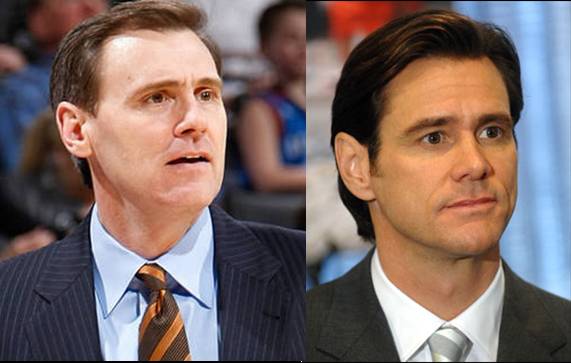
Separated at Birth – NBA Edition

June 11, 2011

I know I’m not the first person to notice this, but since I rarely watch the NBA, this was news to me.  Jim Carrey and Dallas Mavericks coach Rick Carlisle.


And, at the request of someone close to me:  Chris Bosh and that guy from Monsters, Inc.


Robert Louis Stevenson on the modern political era

June 10, 2011

The Robert Lewis Stevenson essay “Crabbed Age and Youth” has gotten more than a few references today among the commentariat. I think I know why.

The sentiments of a man while he is full of ardour and hope are to be received, it is supposed, with some qualification. But when the same person has ignominiously failed and begins to eat up his words, he should be listened to like an oracle.

How can you read that and not think of Rep. Anthony Wiener, he of the screaming match in the well of the House, and ten days of “I can’t say with certitude that it’s not me”?

Most of our pocket wisdom is conceived for the use of mediocre people, to discourage them from ambitious attempts, and generally console them in their mediocrity. And since mediocre people constitute the bulk of humanity, this is no doubt very properly so.

“Pocket wisdom”, an elegant phrase for talking points, dumbed down to the point of becoming a bumper sticker then repeated ad nauseam, deleting any nuance or meaning from the words and leaving them as mere slogan.  The section below makes the point more bluntly.

To have a catchword in your mouth is not the same thing as to hold an opinion; still less is it the same thing as to have made one for yourself. There are too many of these catchwords in the world for people to rap out upon you like an oath and by way of an argument. They have a currency as intellectual counters; and many respectable persons pay their way with nothing else. They seem to stand for vague bodies of theory in the background.

Robert Louis Stevenson knew their types

This essay was written in 1877.  But for the colorful and challenging language, it could have been written last week.  Which leads to one last point:  ‘Twas ever thus.  It is common to think of the modern age as facing more partisanship, bigger legislative challenges, greater financial crises than those faced before.  It may be bad now and the days may be dark and disheartening as we watch our current crop of politicians and elected officials flail away.  But we’ve been through it before and will go through it again.

P.S.  Anybody tells you that the internet and twitter are full of junk should be referred to this post and the originating twitter messages.  The RLS essay is one that I’ve never read and spent the day contemplating.  You can learn things on this gizmo, amid all the clutter.


Californians Face Consequences of Their Actions

June 8, 2011

California is a dreamland for many people. It’s got everything: oceans and beautiful beaches within driving distances of towering mountains, a beautiful climate and beautiful people. Beautiful and righteous and self-assured and confident people.

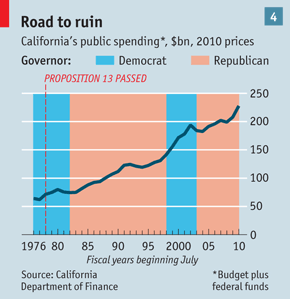
Indeed, it is a land full of dreamers. Economic dreamers, with a really screwed up method of passing laws via a popular voting scheme known as propositions. Nowhere does the residential real estate market boom and bust with as much severity as it does in California. And nowhere has the concept of the economic free lunch gotten a bigger and more exhaustive workout. Passed in 1978, Proposition 13 limited the growth of property taxes and heralded the coming of age of the anti-tax movement and presaged the rise to power of Reagan and the conservatives. The basis of the proposition was to force a shrinkage of government by starving it of revenue, but while Californians have been quite good at cutting their own taxes, they have been dismal at cutting spending.

They can

The Economist recently devoted a special section to the budget troubles that California’s penchant for cutting taxes and not reducing spending has caused. They do a better and more thorough job of the origins of the current budget crisis than I ever could.

The budget crisis triggered by Prop 13 and the lack of any fiscal discipline is only part of the picture.

About twenty years ago, rock-ribbed conservatives and “tough on crime” types thought that liberal judges were being too lenient on repeat offenders. It was thought that taking the optionality out of sentencing would fix the problem and get criminals off the streets. The wave of “three strikes and you’re out” laws that swept the nation in the early 1990’s hit California in 1994. Fueled by outrage over the murder of 12-year old Polly Klaas by a violent criminal out on parole, Proposition 184 passed in a 72% landslide.  The law stipulated that a third felony conviction would result in effective life imprisonment if the first two felonies were deemed to be either violent or serious.  The public was sold on it as a way to keep career criminals who rape women, molest children and commit murder behind bars where they belong. Emily Bazelon’s 2010 article for the New York Times Magazine provides evidence that the law was written much more broadly than advertised.  One of a man with two convictions was sentenced to life in prison for stealing about a dollar in change from inside a car.

The law was amended once to permit offenders involved in drug offenses to get treatment and not life in prison and once to cut the punishment for non-violent offenders to “only” 25-years. According to some, the law has had bizarre consequences. Two-time offenders about to be caught occasionally aggressively resist arrest and risking the lives of police officers and innocent bystanders to avoid capture. Two-time offenders apparently request parole out-of-state to reduce the likelihood of committing a third crime in California and thereby export potential future crimes to other states.

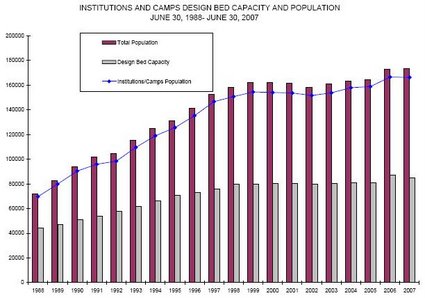
Note that the graph stops in 2007

Largely as a result of not being able to release non-violent offenders under the Three Strikes law, California prisons now hold over 140,000 inmates (down from 160,000 a couple of years ago) in a system built to handle 80,000. The general estimate is that it costs the California about $50,000 per year to hold and care for each prisoner. So…the costs adds up.

Until as late as last week, it was possible that the ordinary Californian did not view the combination of Prop 13 and Prop 184 as necessarily conflicting. Taxes remained at below-market levels (that is, below the level that, given desired spending would balance the state’s budget–more on this below). Three-time criminals were taken off the streets for long periods, effectively eliminating the risk to the population.

Enter Justice Anthony Kennedy and his four compadres on the Supreme Court, who last week ruled that the conditions in the wildly overcrowded state prisons constituted “cruel and unusual” punishment.  In short, Justice Kennedy’s opinion mandated unspecified changes but suggested a range of possibilities, including releasing up to 40,000 prisoners.

The text of Justice Kennedy’s opinion show the shocking conditions in which prisoners are being held.  Those conditions in the prisons were a direct result of a lack of funding from the California legislature–a lack of funding that is a direct result of a cash-starved system brought on by Proposition 13.

The symmetry is both appalling and beautiful.

Of course, the legislature could reallocate funds from other programs to build more prisons to reduce overcrowding and improve conditions, but in a state in which more money is already spent on prisoners than on education, the unpopularity of such an idea is manifest. It surprises no one that California taxpayers would rather have the limited resources of the state spent on them instead of the people they decided should be wards of the state in the penitentiaries.  In short, this is another story of promises made that cannot afford to be kept, of the gutlessness of legislators to find the political courage to make hard and unpopular decisions.

The voters of California put themselves in an irreconcilable position–low taxes and a booming, unmanageable prison population.  Something had to give.   The sad fact is that while this particular problem is limited to California, it represents a precursor to similar problems in every state and municipality in the country.  It is our future, too.


Freedom: What People Do to Achieve it; How We Waste Ours

June 4, 2011

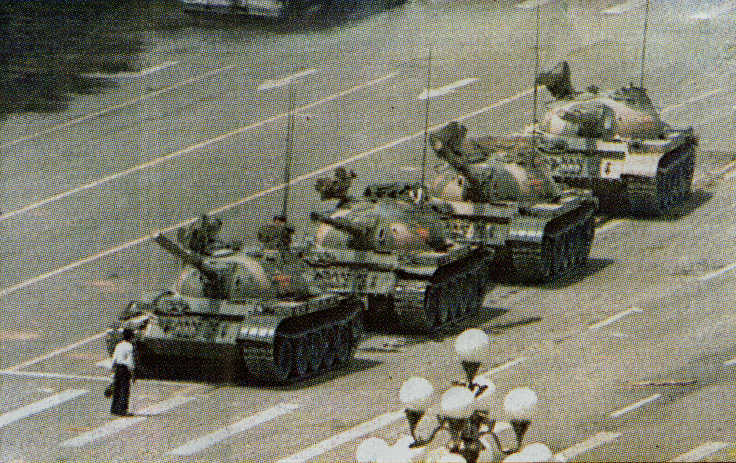
He's not asking for the phone number to vote for American Idol.

Today, June 4, 2011, marks the 22nd anniversary of the uprising in Beijing’s Tiananmen Square.  Events like this and the Arab Spring always make me reflect on what people will do to be free.  It gives me confidence that over the long-term, tyranny cannot prevail.

At the same time, it forces me to think about what we in America do with our freedom.  Endless hours of “entertainment television” focused on the lives of actors and actresses and other publicity-seekers.  So-called reality shows involving people who brag about having only read two books in their lives. A generation seemingly proud of its ignorance; demonstrations of intelligence viewed as betrayals of heritage and race.  Clowns thinking they ought to be president and a media willing to play along all for the sake of ratings.

Top it all off with only one-third of registered voters showing up at the polls on any given election day, and many other people eligible to vote not bothering to register–in part because they don’t want to get called for jury duty.

By our actions we disgrace those that have and will lose their lives in search of the freedom we have attained.

UPDATE:  I see no small irony in the fact that Li Na of China won the French Open earlier today.  In the long run, the protesters in Tiananmen will win.


Media Serves Its Own Interest, Not Ours

June 2, 2011

Despite that we’re more than 500 days from the 2012 presidential election, we are constantly being bombarded with polls about the Republican race for the nomination.  The media lives to tell us who is up, who is down and who isn’t registering above the margin of error.

Some media people I know used to tell me way back before the internet era really began, “You’d be surprised how much information it takes to fill 24 hours per day, 7 days a week of television air time.”  So, looking for anything to write or talk about, we get these polls, among other things.  It’s a complete waste of time and resources.

Now comes The Architect, Karl Rove, speaking truth.  In a piece published today, Rove says, “…polls taken 300 days before the election [have] almost no predictive value.”

So why are media companies paying to have them done?  To simply have something to talk about, because a poll today will neither affect nor predict the outcome of the nomination race.  It’s nonsense to pay any attention to these numbers.  Don’t.  And avoid media outlets intent on pushing them on you.

A serious country deserves a serious media.  As evidenced by what (little) we collectively read and what (and how much) we watch, it’s not hard to conclude that we aren’t serious, and neither is our media.  This is a chicken/egg problem of the first order.


NY-26 – A Lost Opportunity

June 1, 2011

I can’t help but feel saddened by the way the race in the 26th Congressional District of New York played out. Democrat Kathleen Hochul’s upset victory in a district that has been reliably Republican for decades means that we have lost an important opportunity to change the discussion in Washington regarding entitlements in general and Medicare in specific.

Having used “Grandma” and the potential effect of the Affordable Care Act on her care as a campaign tool in the run-up to the 2010 mid-term elections, the GOP faced Grandma themselves as Democrats trotted her out as a “victim” of Rep. Paul Ryan’s (R-WI) budget plan. (Many found Ryan’s plan to be “courageous”, but I wasn’t one of them. Being courageous means taking on your party’s sacred cows. Ryan’s plan does none of that.)

Few things are more disturbing to me, a voracious consumer of news and information, than seeing someone (typically elderly) holding a sign that says “Keep your government hands off my Medicare”. Ugh. Ignorance is the new black.

So the Democrat Hochul tattoos her Republican challenger Jane Corwin with the Ryan Plan, specifically the Medicare plan and pulls off an upset. As a result, we now know the playbook for Democrats across the country for the 2012 election. Keep Your Hands Off Medicare. Run against the Medicare portion of the Ryan plan.

And in that, we have lost an opportunity. Medicare and Social Security and every government program needs to be reassessed. Putting an electric fence around the two biggest programs the government runs will prevent us from solving our country’s fiscal problems. Promises were made in the past that can no longer be kept. Narrow-minded, parochial interests that advance a political and “power-oriented” agenda will keep us from fixing these problems.

When you’re in the business of politics, your job is to win elections. You’re not much of a politician if you’re out of power. As a result, the priority is on winning elections, not solving the country’s problems.

So long as the Grandma formula works on voters, we’re in a bad place with no hope of getting ourselves out of the mess we’ve made of our finances. We have to get serious about this and quickly. We all have to sacrifice and change the paradigm of what we expect government to deliver.


Chicago Weather (continued)

May 29, 2011

During the winter months, it is common for people from non-snow environments to taunt their northern brethren with smart-ass comments like “It we may get thunderstorms but you don’t have to shovel rain.”

In the immortal words of John Kennedy:  “Let them come to my back yard” where two pumps are moving the accumulated 6″ of water at a combined rate of 3,000 gallons per hour.

Excessive Moisture Accumulation

Oh…wait.

I’m now told that President Kennedy didn’t invite the Germans to his back yard, but to Berlin.  Which seems odd, because Kennedy wasn’t from Berlin and it’s rude to invite people over to someone else’s house without their permission. You would have thought that he would have had better manners than that.

Whatever.  My back yard is still flooded.

. . . . . . . . . . . . . . . . . . .

This morning, I participated in my second “Bike the Drive“, an annual event in which they close Lake Shore Drive to autos from 5:30AM until 9:30AM and allow anyone willing to pay $45 to ride on the road.  Last year was a great ride.  A beautiful day matched my then-new enthusiasm for riding and I breezed through 45 miles and could have gone further.  This year, there was a dense fog warning and the temperature was 55 degrees.  Driving to Grant Park, visibility was less than a half-mile.  It was very disconcerting because I honestly had no sense of where I was.  The lack of visible landmarks left me feeling lost on a road I’ve driven thousands of times.

Once on my bike, the fog thickened with every half block I got closer to the lake, and a light mist was in the air.  On the southbound leg, the fog was so thick that it was difficult to see McCormick Place–one of the largest buildings in the world–until you were right on top of it.  The northbound leg was into a nice cool breeze.

So let me summarize:  Out the door at 5:15am, on my bike at 5:45.  Fifty-five degrees.  Fog. Mist.  Into the wind on the uphill part of the ride, in addition to my self-generated 15-18 mph wind from my mediocre pedaling.  The moisture in the air meant that riding was not only more difficult but more dangerous.  There were a couple of times when I hit my breaks and nothing happened.  I didn’t see any accidents (last year I passed about five accidents, all involving speed differential between casual riders and racers, and one in which a mid-50’s rider had a heart attack and died on the course).  Mercifully, I didn’t see any of that this time.

My initial goal was to do two complete loops of the course or 60 miles.  My lack of pre-BTD training due to Chicago’s fantastic spring weather, combined with a very long walk on the golf course yesterday in bog-like conditions and today’s wonderful weather left me grateful to exit the course after one loop.  Thirty miles.  I was gassed before I started.  Even a good playlist on my iPod couldn’t pull me through.

Besides, I had to hurry home to begin building my Ark.

P.S.  What’s a cubit?