The Economics of Not Working Out

January 15, 2012

Proposition: Anyone that vows to go to the gym more but doesn’t shouldn’t complain about Congress not being able to pass bills that cut spending.

From Derek Thompson in The Atlantic:

One in eight new members join their fitness club in January, and many gyms see a traffic surge of 30 to 50 percent in the first few weeks of the year. Stop by your local gym today, and the ellipticals will be flush with flush new faces. But next thing you know, it will be April, our gym cards will be mocking us from our wallets, and our tummies will have sprouted, on cue with the tree buds.

Here’s what economics can teach us about fitness and the fitness industry.

WHY CAN’T PEOPLE KEEP THEIR GYM PROMISES?
FOR THE SAME REASON CONGRESS CAN’T PASS DEFICIT REDUCTION.

People are way too optimistic about their willpower to work out, Stefano Dellavigna and Ulrike Malmendier concluded in their famous paper “Paying Not to Go to the Gym.” In the study, members were offered a $10-per-visit package or a monthly contract worth $70. More chose the monthly contract and only went to the gym four times a month. As a result, they paid 70 percent more per visit than they would have under the plan they rejected. Why? Because people are too optimistic that they can become gym rats, which would make the monthly package “worth it.” Silly them.

You might call this behavior “laziness.” Economists prefer “hyperbolic discounting.” This is the theory that we pay more attention to our short-term well-being and “discount” rewards that might come further down the road. Think of a small reward in the distant future, like taking a nap three weeks from now. Doesn’t hold much appeal, does it? But when the small reward is imminent — Take a nap right now? Woo hoo! — it’s considerably more attractive. Given the choice between small/soon rewards versus larger/later benefits, we’ll take the former. Hyperbolic discounting helps to explain why Congress can’t pass deficit reduction, why drug addicts stay addicts, why debtors don’t pay off their bills, and why you keep telling yourself that the right day for exercise is always “tomorrow.”


Socialize The Losses – Bain Capital Edition

January 13, 2012

From Craig Crawford, more evidence that Mitt Romney has some serious ‘splainin’ to do. The problem is that every transaction is its own story and there were many transactions.  The drip, drip, drip of these things is more than his staff can possibly prepare for and more than he can ever finish explaining.  No one will want to hear the full explanation, let alone believe it.

I disagree with Crawford’s conclusion.  This is not socialism.  This is deal-making in America. This IS capitalism, or at least what capitalism has become. The obvious problem Romney’s going to have is that the American people don’t like this kind of thing. This is the ‘rigged system’ in which society takes the loss while the rich guys rake in the dough that the Occupy Wall Street movement has tapped. This is TARP followed by giant, seemingly unjustified investment banker bonuses. This is the Goldman Sachs getting what looks like a sweetheart deal on its AIG exposure courtesy of their alumni network at Treasury.

Here’s Crawford’s post in full from the Huffington Post.

Romney now says big government is anti-American but he wasn’t shy about feeding on the federal trough when he got the chance.

As a self-described “capitalist” he successfully lobbied the Federal Deposit Insurance Corp. to forgive his company’s debts.

Romney’s rescue of a business consulting firm was achieved in part by convincing the Federal Deposit Insurance Corp. to forgive roughly $10 million of the company’s debt. — The Boston Globe (10/25/1994).

When a steel mill Romney had bought failed, thanks to massive debt he had saddled it with, his firm — Bain Capital — got the feds to bail out the mill’s pension plan, while he walked away with huge profits.

A federal government insurance agency had to pony up $44 million to bail out the company’s underfunded pension plan. Nevertheless, Bain profited on the deal, receiving $12 million on its $8 million initial investment and at least $4.5 million in consulting fees. — Reuters

Romney now equates any attacks on his business dealings as an assault on free enterprise. But his version of capitalism was all about relying on government to cover his losses. Sounds more like socialism to me.

Craig blogs daily on craigcrawford.com.


The Fallacy of Health Care “Uncertainty”

January 5, 2012

I was talking to a friend of mine for the first time in a couple of years yesterday. We used to work together and engage in lively discussions on the topics of the day.

My friend now finds himself involved in a small business. We talked of the differences between our old existence at a major corporation and how we thought about employee benefits versus his current thinking as a buyer of those services (and not simply as a consumer of whatever the HR department already purchased) and someone charged with watching every corporate penny.

The subject turned to health care.

My friend talked of an “almost universal hatred of Obama and the health care law” within the small business community that he knows. “The cost to hire new employees has gone through the roof and on top of that is all the uncertainty associated with health care.”

“Uncertainty?” I asked. “There’s no uncertainty.  The health care law has been enacted and is in effect. The only ‘uncertainty’ about the law is from Republicans talking about undoing it and repealing it,” I told him.

“Oh,” he said.  “I guess you’re right. I hadn’t thought of it that way.”

Well maybe you should from now on and stop complaining about problems that don’t exist, I did not add.

“It was good talking to you,” I said.  “I’ve missed our little chats.” And my chance to set you straight on what’s really happening.


A Few Seconds of Sanity

January 3, 2012

I am not a lover of poetry. I am not a lover of Garrison Keillor. I have, however, been taken in by The Writer’s Almanac podcast. It’s a daily show that runs about five minutes that’s sponsored by The Poetry Foundation and available on iTunes. Keillor reads a few bits of information about what happened on that particular day in literary history (so that I get my fix of information; everything I do involves gathering some information for later use), then reads a poem. I find myself listening to the podcast on my way home–either on the train or on my twelve-minute walk from the station to the house. There’s something about the tone of his deep, resonant baritone voice and the pace at which he reads that I find quite calming and soothing, especially after a day at the office. As a result, I’m hooked.

There was one poem that particularly caught my ear a while back, called “The Return of Odysseus” by George Bilgere. It is reprinted in full below, but to get the full effect I’d suggest you go to the link here and have Garrison Keillor read it to you. It should become obvious why I’ve become so enamoured of this particular work and the daily dosage.

Enjoy.

The Return of Odysseus

by George Bilgere

When Odysseus finally does get home
he is understandably upset about the suitors,
who have been mooching off his wife for twenty years,
drinking his wine, eating his mutton, etc.

In a similar situation today he would seek legal counsel.
But those were different times. With the help
of his son Telemachus he slaughters roughly
one hundred and ten suitors
and quite a number of young ladies,
although in view of their behavior
I use the term loosely. Rivers of blood
course across the palace floor.

I too have come home in a bad mood.
Yesterday, for instance, after the department meeting,
when I ended up losing my choice parking spot
behind the library to the new provost.

I slammed the door. I threw down my book bag
in this particular way I have perfected over the years
that lets my wife understand
the contempt I have for my enemies,
which is prodigious. And then with great skill
she built a gin and tonic
that would have pleased the very gods,
and with epic patience she listened
as I told her of my wrath, and of what I intended to do
to so-and-so, and also to what’s-his-name.

And then there was another gin and tonic
and presently my wrath abated and was forgotten,
and peace came to reign once more
in the great halls and courtyards of my house.


Federal Tax Redistribution And Voting Patterns – A Study in Hypocrisy?

January 3, 2012

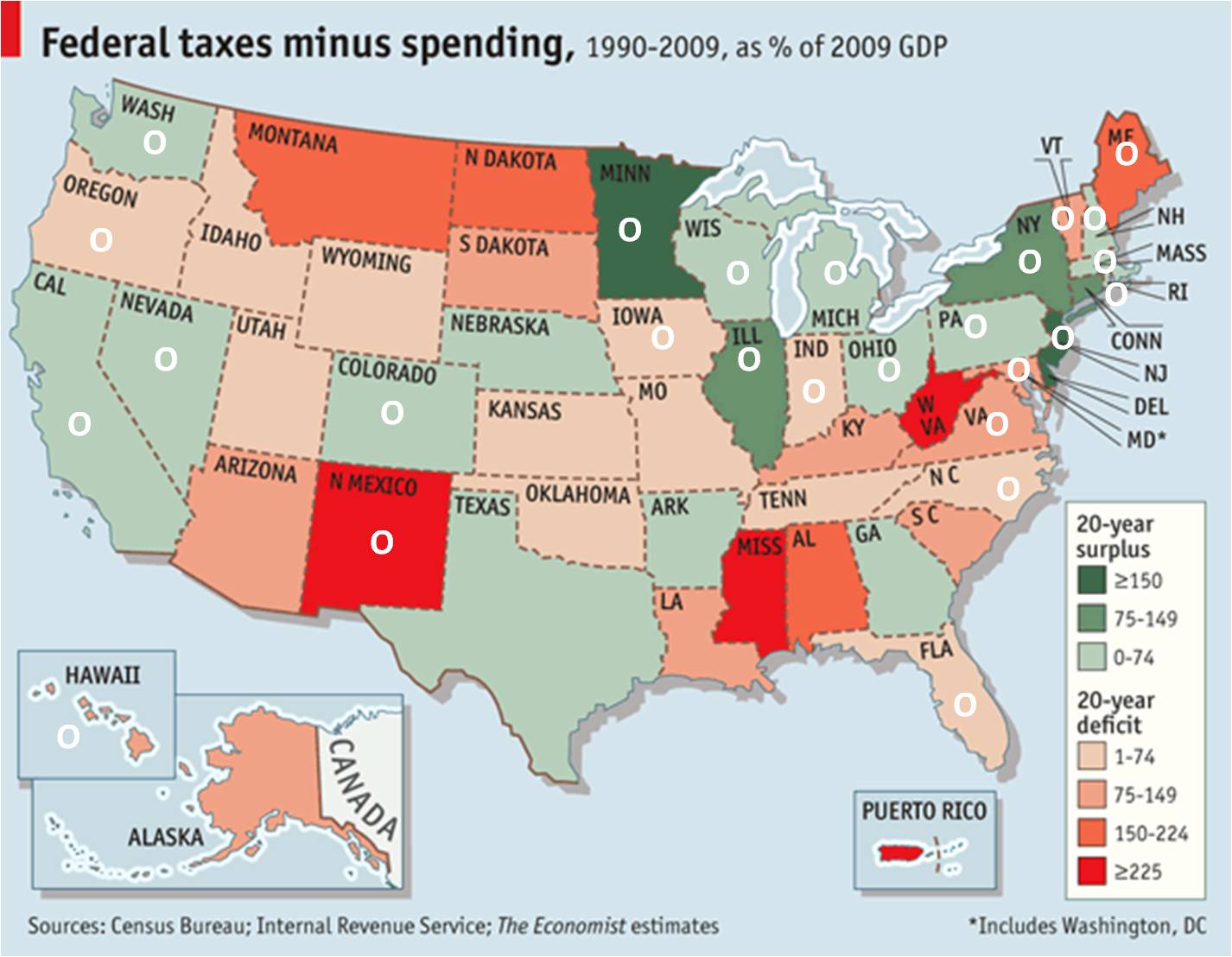
I saw the picture below yesterday. (I apologize that I can’t find the link to the article, but I saw it on The Economist.  If I find it, I’ll link to it.) It shows the differential between federal taxes paid and federal spending within each state. The green shades represent more paid in federal taxes than the state received in federal spending. Shades of red represent states that received more in federal spending than their residents paid in federal taxes.  That by itself makes it an interesting graphic. I have enhanced the chart by overlaying it with the 2008 election results.  States shown with a “O” went for Obama; those without designation went for McCain.

The Givers in Green, the Takers in Red

What you notice is that most of the states shaded in green (the “Givers”) went for Obama.  Voters in states that pay more into the federal government than they receive voted for a guy that some caricature (then and now) as a “socialist” and “redistributionist”–their words not mine. Said another way, those people who already have wealth redistributed away from them and toward those in other states voted against a guy that professed to want to reduce the size of the federal government and cut their tax bills.  Of the 22 green states, only four (Texas, Nebraska, Arkansas, and Georgia) voted for McCain, the professed tax-cutter and government-shrinker.

On the other side of the ledger are those states that are the Takers; those that get more from the federal government than they send in. These guys are already not paying their own way and benefit from the largess of the federal government.  There are 28 states than get more than they give. Of those, 18 of them voted for the Republican nominee.

Is this not biting the hand that feeds? If those states want the government to be smaller, I can think of 18 places to reduce the federal budget. But until you start paying your own way, don’t you owe it to those that are paying the bills to at least shut up?  This is like having your teenager tell you that the family wastes too much money dining out but then asks for money to go out for pizza with his friends.

As with many things, ’twas ever thus.


Over and Under

December 28, 2011

I’m overfed and underslept.

I’m overeasy yet undercooked and overstimulated though underacheived.

Overworked and underappreciated and overbearing but underestimated.

I’m overdubbed but underplayed; oversupplied yet underfunded.

I’m overinflated and underwater; overcharged and underperforming.

I’m overmatched and undervalued.

I’m overjoyed and under attack!

I’m covert and undercover.

I’m overcome and understanding.

I’m overweight and underfoot.

I’m under-reported and overused.

I’m undersexed, yet somehow overblown.

I’m understaffed and overseen.

I’m undermined and overheated.

I’m underwhelmed and overserved.

I’m under God and overconfident.

I’m understanding and overcome.

I’m underused and overtired.

I’m the underdog and overridden.

I’m overacting and underrated.

I’m overstated and underclassed; overeager and undercut.

Overdrawn.  Am I understood?


Swing And A Miss Marketing

December 20, 2011

We received a 2012 calendar from a local business yesterday. It’s one of those with the calendar on the bottom and pictures of Chicago on the top. The calendar has helpful reminders like February 10th which shows “Monster Truck Jam, Allstate Arena, thru 2/12; Girls H.S. Bowling Tournament, Rockford, thru 2/11”. Be sure to note that on July 4th there’s an entry for “4th of July Parade, Arlington Heights.”  I grew up in Arlington Heights and it’s got a great 4th of July Parade, but so do lots of communities around here, most notably, right next door in Evanston.

A quick flip through it revealed a curious set of pictures; one that only occasionally shows the beauty of our city.

January: A snow-covered Grant Park
February: The Belmont ‘L’ Stop in a blizzard
March: A very thin view of the very green Chicago River photographed through several nondescript buildings

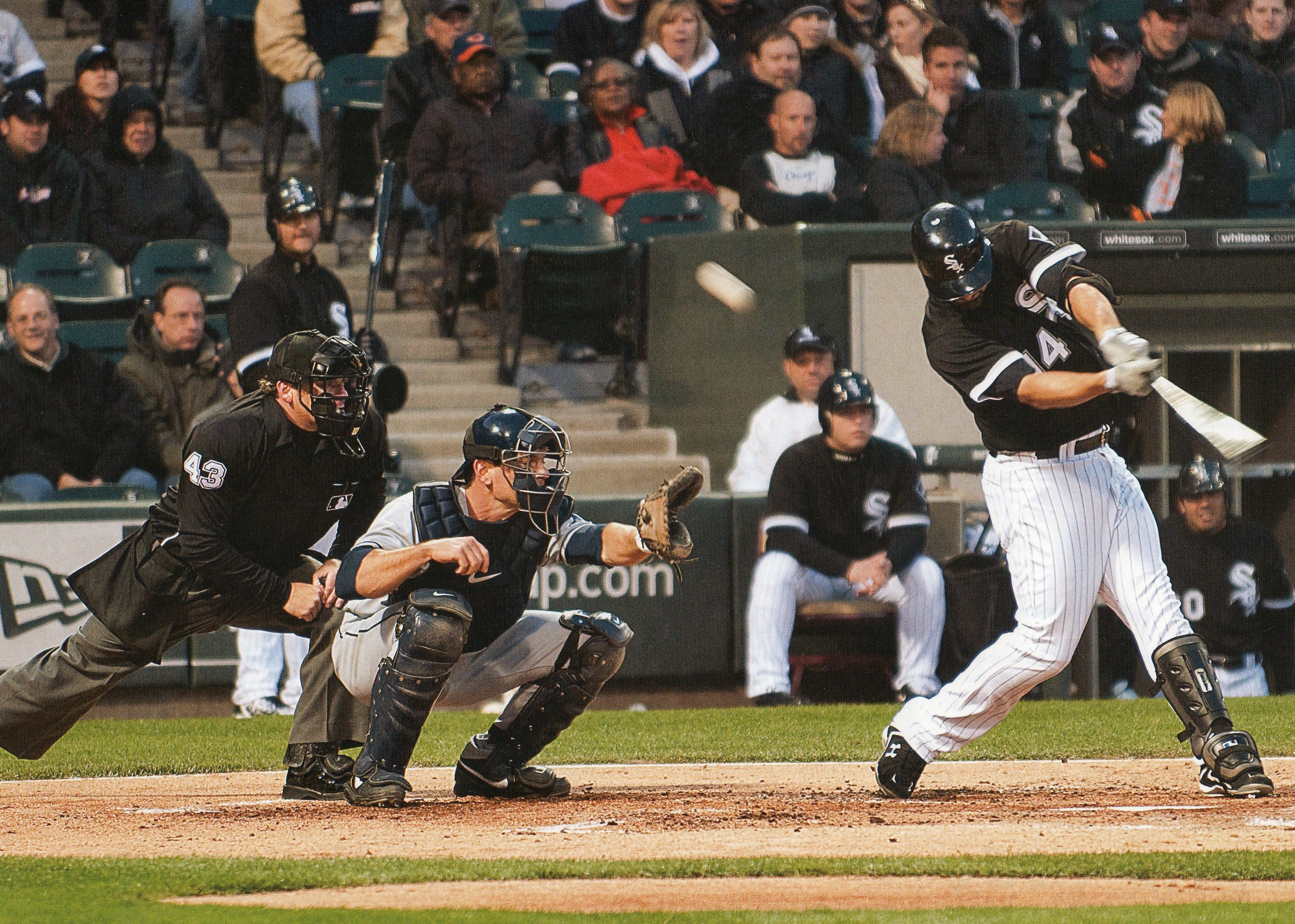
May: An unidentified White Sox player is fouling off a pitch (the ball is above and behind him as he swings); not hitting a home run or even getting a single.  A foul ball; strike two!  In the background are Sox fans huddled in parkas and ski hats, looking generally displeased.  (It has occurred to me that you could take a picture at a Sox game on the most beautiful day imagined and it could be appropriately captioned “Sox fans looking generally displeased.”)  Not only is the photo of something not-so-great happening, there are a grand total of zero happy people in the picture.

He fouls it off for strike two. And let's immortalize this moment, shall we?


July: Fireworks at the lakefront, although there’s nothing in the shot but smoke, explosions and a few boats in the foreground. A picture taken at a random Wisconsin lake would hardly look different.  Hey, Mr. Photographer!  Have you seen those giant buildings?  They make a wonderful backdrop!

November:  November is my favorite. It’s a photo of a Bears game in Soldier Field. The Brett Favre-led Minnesota Vikings are lined up a the Bears’ 2-yard line and are about to score.  The Bears in the shot are looking around at each other, pointing to one another like they’re not sure who is doing what on the upcoming play.  Now there have been years in which that really is how most Bears games are played, but jeez. At least it’s not snowing!

In a year in which the Bears lose in the NFC Championship Game to the eventual Super Bowl Champs, THIS is the best picture of a football game you've got?!


December: Ice skating in a(nother) snowstorm!

I’ve lived here most of my life and it’s a fact that it might snow in each of the months in which snow is shown falling or having fallen.  I also understand that snow makes for interesting photographs, but looking at the calendar as a whole, you’d swear it snowed all the time and the calendar might be for a more picturesque version of Minot.

That makes seven (7!) of the twelve months with inexplicably bad pictures in them! I’m sure that the nice people who own the business that sent the calendar merely bought it as a completed project and put their advertisement on it as opposed to personally having selected the pictures, so I assign no blame to them.   They were just unwitting sponsors of this train wreck of a marketing piece.


Touring the Wine Cellar

December 13, 2011

Let's see what's behind door number 3!

It’s holiday party season, and we’re making the rounds to various holiday gatherings again.

Whether it’s a dinner party or a cocktails and hors d’oeuvres gathering, the wine typically flows generously. At some point in the evening, typically after the main course and while the ladies are clearing (!) and preparing for desert or after all the guests have arrived and the cocktail party is well underway, the question is inevitably asked, “What  are we drinking tonight, Dave?”

“Well,” Dave will say, “let’s take a tour of our wine cellar, and check it out.  Shall we?”

This is the 1%ers way of saying, “let me whip out my manhood and show you how large it is!”

“No, really,” I say.  “Thanks anyway.  I’ll catch up with you later.”

I don’t tour wine cellars.  In particular, I don’t tour “cellars” that are merely rooms in suburban basements and ones not large enough to fit four full-grown adults, like the one I recently encountered.  (I spotted it early in the evening when shopping for an unused bathroom.)  A room that small does not require a “tour.”

Yes, I understand you have a bunch of wine.  Good for you.  I like wine.  I like to drink wine. I have previously seen large quantities of wine bottles.  I’ve been to vineyards and seen even larger quantities of wine.  You possess wine.  Excellent. I am occasionally thirsty and now I know where to go to quench that thirst.

I have a large collection of books, and yet somehow when you’re at my home, I manage to not to conduct tours of my book shelves and regale visitors with the sagas of how I acquired a particularly rare edition of a Teddy Roosevelt biography, or where I was when I read Orwell’s “Shooting An Elephant”, or how blue the sky was over the nearby mountains when I read The Echo Maker.

I’ve got a decent collection of scorecards from rounds that I’ve played on some of this planet’s finest golf courses, yet I somehow manage to (mostly!) not hijack the party to talk about the 6-iron I stiffed at the 8th at Pebble in a gale or the 2-iron that tore the flag out of the 17th hole at Merion.  And even if I tell those stories, I don’t drag you downstairs to show you the card.  You believe me, just as I believe you.  You have a bunch of wine and no matter how long the party goes, we won’t be thirsty.

And for that, I am thankful.  Now where’s the corkscrew?


Back Home Again, in Indiana

December 11, 2011

As a freshman at Indiana, my first real college basketball game was the IU vs. Kentucky game on December 6, 1980.  Kentucky, then ranked #2 came into town to play the #5 Hoosiers and I had a seat in the 10th row on the floor behind the basket.  For those that have never been in Assembly Hall in Bloomington, it is one of the worst places to watch a college basketball game (or attend a concert).  It is built with two monster sections on either side of the court, with a very steep balcony on top.  There are only about 20 rows of bleachers behind each basket.

Back then, there was no such thing as a student section–we were randomly placed around the arena.  In those days, you could sign up for only half of the home games.  You had to negotiate with someone (usually a female student) to get the other half of the games.  With the random placement and the chance that you were going to end up either high in the main level or in the balcony that the same view as a satellite in geo-synchronous orbit, those floor level seats were sacred and coveted.

It was loud and it was thrilling.  Indiana ended up losing 68-66. Ray Tolbert missed a dunk in the last minute that would have given Indiana the lead that was right in front of us.  Needless to say, I was hooked.  In my four years at Indiana, the only home games I missed were those that occurred when we were on break.  I skipped spring break my freshman year to attend the NCAA regionals being held in Bloomington.  We ended up winning the national championship that year, and the stories about that season and that night are still being told thirty years later.

This is all a long lead-up to the flashbacks I’ve had since late Saturday afternoon, when Indiana’s basketball program returned from the dead to beat the (then) #1 ranked Kentucky Wildcats.

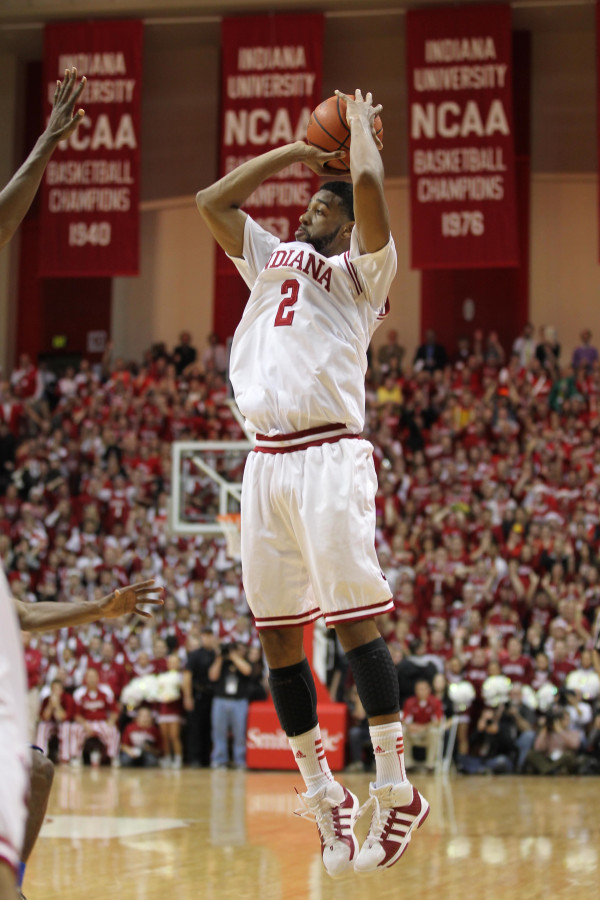
Watching the game was a treat and featured me pacing and jumping and agonizing over what seemed like an opportunity lost.  And then Christian Watford took a pass and drained a twenty-six foot jump shot that people will be talking about in Bloomington for years to come.

Moments before chaos reigned

Indiana’s basketball program was good in my day.  We expected to win our home games, even against people ranked higher than we were.  As a result, we never stormed the court.  It was fun to watch the kids take the court yesterday. The end of the game and the aftermath were jubilant.  Here are several views.  The first with longtime Hoosier Radio Network announcer Don Fisher’s call dubbed over the ESPN video.

This one is my favorite.  It’s amateur video taken from about 20 rows up in the main level, so it lacks the announcers, but gives you a great idea of the explosion of sound as the game ended.

Finally, my favorite watering hole while on campus (and now) was Nick’s English Hut.  When Indiana beat Michael Jordan’s North Carolina team in 1984 to advance to the regional finals when I was a senior, I was standing on the table and hanging from the beer barrels that hung from the rafters.  So it’s a place with wonderful memories for me.  Here’s a video taken from within the “addition” in Nick’s–not the old staid part but the part that looks like a sports bar without seating.  The video shakes and moves so quickly that the neon signs look like fabulous modern art works.


A Resolution for 2012

December 7, 2011

I’ve never been one for making (or keeping) New Year’s resolutions, but I think I’ve got one that’s worthwhile and easily accomplished.

Beginning in 2012, I resolve that we keep all our plates and glassware and silverware not in the kitchen cabinets, but in what has become their adapted environment–our 15-year old son’s bedroom. Like hippos and ibis and antelope and gazelle congregating around the watering hole on the African savannah, the ice cream bowls, soda glasses, smoothie and yogurt spoons and sandwich plates gather on the desk and nightstand and, well, any flat surface. The growing herds awaiting the lion (me) to come and order them temporarily away.

I figure keeping them up there will both save us a step (we’ll always know where to find them!) and free up the cabinet space in the kitchen for more useful things like the jumbo jars of Nutella he wants us to buy.