The Dashed Hopes of Web 2.0 and User-Generated Commentary

April 27, 2012

One of the much-discussed benefits of the internet and “Web 2.0” is that it is interactive and designed for collaboration, with user-generated content creating a virtual community.

You’ve probably searched for a business online and read reviews of their work. To no one’s surprise, I’ve always been a little skeptical of the comments on those sites. I always feared that it was too easy for someone (the business owner, their family members, their advertising or PR firm, etc.) to fill the site with rave reviews.

Fear no more! It’s really happening! Enter Reputation.com.

According to their website, “We make sure customers only see the truth about your business by eliminating negative material from your top search results…” even if those negative reviews are deserved!

Our publishing team will create custom profiles and other content for you or your business to build a positive online presence, and our expert reputation advisers will work with you to push down or suppress any negative content that shows up high in your search results. (emphasis added)

So there you have it. Negative content suppressed, irrespective of whether it’s true or not. You can officially no longer trust anything you read (in the same way you couldn’t trust any photograph appearing on the web due to Photoshop).

All children are above average. Having access to all this great information and not being able to trust anything but the name, address, phone and web address of a business isn’t very helpful. Some progress.


Burned into Memory

April 20, 2012

We saw this on Letterman when it originally aired in 1987, when Dave was still on NBC and Paul Shaffer’s band was just four guys–four guys with 80’s hair. We’ve been talking about it ever since, because, as you’ll see, once you see Bobby Badfingers, it gets burned into your memory. Mercifully, it has not caused any nightmares, just laughter every time we hear “Wipe Out!”

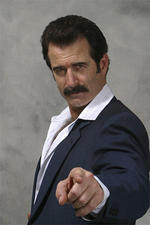
UPDATE: According to SF Weekly, Mr. Badfingers (pictured nearby) “quit selling RVs in 2000 to tour full-time. He was temporarily slowed down a year ago when San Francisco cops jailed him for a week…but he quickly bot back to business producing Web pilots for a finger-snapping focused children’s television show.”

Look what has become of Bobby Badfingers.


A True Masters Tale

April 4, 2012

My wonderful father-in-law Pete knew Frank for many years; probably most of their lives. They belonged to the same country club and played golf together many times. Their wives were friends and had grown up together, too.

I met Frank in 1984, when I started dating my now wife and making what seemed like weekly trips to visit her parents and her high school friends. I wasn’t complaining because a weekend in Dayton usually meant golfing with Pete and his buddies. I played with Frank and his sons-in-law several times, and got to know him a little bit in the process.

In the fall of 1991, Pete just happened to mention to Frank how much he’d love to one day go to Augusta and see The Masters Tournament. Frank responded in a surprising way.

“You really want to go? I’ve had tickets for thirty years. You can take mine.”

While I wasn’t there to witness it, I can just imagine the look on Pete’s face. How did he know Frank for this long and not know that he had Masters tickets?! Apparently Frank had tired of going at some point in the late 60’s or early ’70s and just stopped going. For reasons that aren’t clear, he kept getting the tickets thought. Thank goodness.

Come April 1992 and Pete goes to Augusta for the first two rounds, and has the time of his life. I was very happy for him–jealous, but very happy.

At some point during that summer, Frank and Pete were playing golf again and the subject of The Masters once again came up.

“You know who would really like going to Augusta?,” Frank said to Pete. “Your son-in-law, Mark would really like it, wouldn’t he?”

I have no idea what Pete said in reply, but I’m pretty sure it was something like, “DUH!!” The next time I was with Pete, he told me of the offer. To say that I was stunned and elated doesn’t do it justice. Two passes for all four days of the tournament. A dream fulfilled.

Thanks Frank!

So on Tuesday, April 6, 1993 with my best friend growing up at my side–the brother I never had, the best man at our wedding and the guy who could never figure out how to beat me on the golf course*–we headed for Augusta. Being novices and the internet and Google not having been invented yet, we struggled a bit on lodging and ended up staying about an hour outside of Augusta in South Carolina. On the drives to and from the hotel, we had a running bet on the amount of road kill we’d pass. It was always double digits as I recall.

Back then, the practice rounds were open to the public. All you had to do was walk up and buy a ticket. The real reason for going early was that you could take pictures during practice. The camera wasn’t the greatest and the day was full of glare, but they’re some of my favorite photos. My impressions of the golf course and the experience of being there are beside the point of this piece. Suffice it to say that it’s the most beautiful inland golf course I’ve seen and one that has much more dramatic changes in elevation that you’d ever imagine from watching on TV.

On Friday after the second round I bid farewell to my friend and went to the Augusta airport to meet my golf nut father, who was going to join me for the tournament’s last two rounds. It is an experience that he still talks about, and one that I’m so happy to have been able to share with him.

With us standing nearby, Chip Beck laid up and 15 and basically conceded the tournament to Bernard Langer, who won his first green jacket. As the leaders headed up 17, my dad and I headed back to Amen Corner for one  last look–one undisturbed by the mobs of people (make that “large numbers of patrons”–the members of the Augusta National Golf Club frown on “mobs”, just ask Jack Whittaker).

There are few places prettier than a golf course late in the day, when the sun is low and the shadows of the trees get long and stretch across the vast green of the manicured acreage. This is true of any golf course, but in the gloaming of that spring evening, in the shadow of the hundred-foot tall loblolly pines, the beauty of the place left us speechless as we walked.

We spent the night in Atlanta and flew out early the next morning. I was already composing the Greatest Thank You Note of All Time in my head. There was no way I could do that experience justice in a few lines of a note to Frank, but I tried.

I’d be lying if I told you that I didn’t think about subsequent visits to Augusta with Frank’s tickets. After all, he was tired of the hassle of going to the tournament.

I know many people who have gone to the Masters; some who go every year with clients. I think that the way the tickets came to me make my trip there infinitely more meaningful and special. I’m glad that’s how I got to go.

. . . . . . . . .

Later that summer, I heard the awful news. Frank had had a heart attack and died. Although not a young man, his passing was too soon and quite sad for his family and those that cared about them. And no, the subject of what was going to happen to the tickets never came up.

. . . . . . . . .

While my own Masters story ends there, at this point the story of Frank and the Masters Tickets took an interesting turn.

When the 1994 Masters ticket application arrived, not surprisingly Frank’s widow returned it to the Club, telling them of her husband’s passing. Several years later Frank’s widow remarried, and to a real golf fan, no less. Her new husband heard the story of the legacy of the ticket. Hearing it, he…ahem…strongly urged her to contact Augusta National and see if she could get the tickets back. (Had it been me, it would have been “YOU DID WHAT? YOU GOTTA GET THOSE TICKETS BACK!”)

Among the truisms in American sports is that the Masters pass is the toughest ticket to get (without scalping). The waiting list for getting tickets was established in 1972 and closed in 1978 when it became so long that those at the back of the line had no realistic chance of making it to the front in their lifetimes.** It was in this “there is no waiting list” period that Frank’s widow contacted AGNC to tell her story.

It worked. When no one else could get tickets; with the list closed and no hope of getting tickets in your lifetime, she got four tickets for as long as she wanted them.

Miracles happen. The men in the green jackets have hearts after all. Amazing.

And every April, I thank God for Frank Furlong.


* He finally beat me a week after the birth of our first child, when I was in such a funk that concentrating for more than 15 minutes was a stretch, let alone four hours. Since then, he’s been playing twice a week and is now a 3 (and yet he still is reluctant to give me the five shots I deserve! Old habits die hard.) and beats me like a drum.

**In 2000, the Club reopened the waiting list briefly. A history of what’s happened since then is here. I’ve won the practice round lottery once, in 2009, and was able to take my son there–something for which I’m eternally grateful.


Limericks 2012

March 17, 2012

Some days the mood strikes me. This is one of those days. The fact that I’m not Irish (not even today) is clear in the liberties taken with the sacred form.

A GOP man named Santorum
Hates sinners and sins, he abhors ‘em.
“Women taking the Pill?
It’ll take us downhill.”
I think ‘twould be best to ignore ‘im.

(I suppose I could have started this with the traditional, “There once was a man named Santorum,” but that would have been conventional and trite and we can’t have that, now can we?)

The hot topic of the day drew me in like an Irishman to an argument.

Those lacking a big frontal lobe
Are prancing all over the globe
Say casual sex
Our nation it wrecks
To dissuade you? The vaginal probe.

______

“Hell no!” U.S. women respond.
“With our dignity you won’t abscond.
You think we’re all tarts
With well-worn girl parts
You can keep your trans-vaginal wand.”

_______

And finally, one for the local boys.

Cub fans think that this is the season
How come? They’re not sure of the reason
Zambrano’s gone south
And he’s taken his mouth
And that by itself is quite pleasin’.

Happy St. Patrick’s Day.


Forever Young

March 17, 2012

A Night to RememberAs much as I love Verne Lundquist and Gus Johnson and some of the other guys that do play-by-play for the NCAA tournament, and no matter how much CBS pushes their saccharine, self-published theme song “One Shining Moment” on me with each broadcast, every time I turn on a tournament game, the only voice I hear is that of Dick Enberg welcoming viewers to the Spectrum in Philadelphia and it’s the Kenny Loggins theme music that they used to use up with a swell.

And I am young again.


You say that maybe it’s over.
Not if you don’t want it to be.
For once in your life, here’s your miracle.
Stand up and fight.

This is it.


Still More on Taking Welfare and Hating It

February 20, 2012

It’s somewhat reassuring to know that the things that I read and find interesting enough to write about are also read and found worthy of comment by people I respect. For those interested in what professional writers and good thinkers have to say about the NYTimes article I discussed here, see this from the Democracy in America Blog from The Economist.

http://www.economist.com/blogs/democracyinamerica/2012/02/americas-safety-net

and added commentary here

http://www.economist.com/blogs/democracyinamerica/2012/02/americas-safety-net-part-two


More on Redistribution and Voting Patterns

February 18, 2012

Having previously written about the subsidization of red states by blue states, I was interested to read last Sunday’s NYTimes article on the seemingly paradoxical, some would say hypocritical, attitudes of people who receive aid and their support of a candidate who advocates reductions to the social safety net. The piece highlights Chisago County, northeast of Minneapolis, an area with little poverty but plenty of people who receive government benefits.

Many people [in Chisago County] say they are angry because the government is wasting money and giving money to people who do not deserve it. But more than that, they say they want to reduce the role of government in their own lives. They are frustrated that they need help, feel guilty for taking it and resent the government for providing it. They say they want less help for themselves; less help in caring for relatives; less assistance when they reach old age.

_____

But the reality of life here is that [residents of Chisago County] continue to take as much help from the government as they can get. When pressed to choose between paying more and taking less, many people interviewed here hemmed and hawed and said they could not decide. Some were reduced to tears. It is much easier to promise future restraint than to deny present needs.

“How do you tell someone that you deserve to have heart surgery and you can’t?” Mr. Gulbranson said.

He paused.

“You have to help and have compassion as a people, because otherwise you have no society, but financially you can’t destroy yourself. And that is what we’re doing.”

He paused again, unable to resolve the dilemma.

“I feel bad for my children.”

_____

The government helps Matt Falk and his wife care for their disabled 14-year-old daughter. It pays for extra assistance at school and for trained attendants to stay with her at home while they work. It pays much of the cost of her regular visits to the hospital. Mr. Falk, 42, would like the government to do less.

“She doesn’t need some of the stuff that we’re doing for her,” said Mr. Falk, who owns a heating and air-conditioning business in North Branch. “I don’t think it’s a bad thing if society can afford it, but given the situation that our society is facing, we just have to say that we can’t offer as much resources at school or that we need to pay a higher premium” for her medical care.

Mr. Falk, who voted for [upset winner over long-serving Congressman Jim Oberstar, GOP Representative “Chip”] Cravaack, said he did not want to pay higher taxes and did not want the government to impose higher taxes on anyone else. He said that his family appreciated the government’s help and that living with less would be painful for them and many other families. But he said the government could not continue to operate on borrowed money.

“They’re going to have to reduce benefits,” he said. “We’re going to have to accept it, and we’re going to have to suffer.”

_____

Support for Republican candidates, who generally promise to cut government spending, has increased since 1980 in states where the federal government spends more than it collects. The greater the dependence, the greater the support for Republican candidates. [Minnesota, it should be noted, is not one of those states. It contributes more to the federal treasury than its residents receive. –ed.]

Conversely, states that pay more in taxes than they receive in benefits tend to support Democratic candidates [like Minnesota does –ed.]. And [Dartmouth political science professor Dean P.] Lacy found that the pattern could not be explained by demographics or social issues.

Chisago has shifted over 30 years from dependably Democratic to reliably Republican. Support for the Republican presidential candidate has increased relative to the national vote in each election since 1984. Senator John McCain won 55 percent of the vote here in 2008.

Residents say social issues play a role, but in recent years concerns about spending and taxes have predominated.

Some of the fiercest advocates for spending cuts have drawn public benefits. Many, like Mr. Falk, have family members who rely on the government. They often cite that personal experience as the reason they want to cut government spending.

Paul Krugman devotes his column today to the Sunday Times article and points out the seeming contradiction of residents of states and communities that receive more aid than they contribute being the most aggressive and adamant in their desire to elect representatives dedicated to cutting benefits.  He offers three theories as to why that might be:

…working-class Americans are induced to vote against their own interests by the G.O.P.’s exploitation of social issues. And it’s true that, for example, Americans who regularly attend church are much more likely to vote Republican, at any given level of income, than those who don’t.

Still, as Columbia University’s Andrew Gelman points out, the really striking red-blue voting divide is among the affluent: High-income residents of red states are overwhelmingly Republican; high-income residents of blue states only mildly more Republican than their poorer neighbors. Like Mr. Frank, Mr. Gelman invokes social issues, but in the opposite direction. Affluent voters in the Northeast tend to be social liberals who would benefit from tax cuts but are repelled by things like the G.O.P.’s war on contraception.

Finally, Cornell University’s Suzanne Mettler points out that many beneficiaries of government programs seem confused about their own place in the system. She tells us that 44 percent of Social Security recipients, 43 percent of those receiving unemployment benefits, and 40 percent of those on Medicare say that they “have not used a government program.”

I agree with much of Krugman’s analysis, but I have a fourth theory. Back to the initial Times article that is the basis for Krugman’s commentary:

Brian Qualley, 49, has a sister who survived a brain tumor but was disabled by its removal. The government pays for her care at an assisted-living facility. Their mother scrapes by on Social Security.

Mr. Qualley said that the government should provide for those who need help, but that too much money was being wasted. Mr. Qualley, who owns a tattoo parlor in Harris, north of North Branch, said some of his customers paid with money from government disability checks.

“They’re getting $300 or $400 tattoos, and they’re wearing nice new Nike shoes that I can’t afford,” he said, looking up from working a complicated design into the left leg of a middle-aged woman. “I guess I shouldn’t say it because it’s my business, but I think a tattoo is a little too extravagant.”

From time to time during my time in Chicago, I have worked with professionals who live among those receiving federal benefits like food stamps and welfare. Yes, I know I live among those receiving federal benefits like Social Security and Medicare, but stay with me on this. Never have I met people more uniformly ticked off about how that aid is used and how it affects their communities. They were in pretty much every case quite adamant about the dangers and perverse incentives of the federal safety net, its unfairness with people getting it that don’t deserve it, and the need to reduce benefits. (The reference to welfare should tip you off about how long ago these days were.) So, like Mr. Qualley, I think that those that see the effects of federal aid on a regular basis and experience it in their own lives understand it in a slightly different way than the rest of us do.* It’s more visceral; they live it on a daily basis.  And as cited throughout the article, residents of Chisago County recognize the untenable position that they and the federal government are in with the generosity of the aid. They know the flow must, at some point slow. They’re doing their part to slow it by electing a budget cutter. Like many an addict, they can’t wean themselves from it so long as it’s offered. Some of them show discomfort for taking it and see what it’s doing to them, but so long as you show up with the score, they’ll take it.

*This was not true of my experience with the safety net. I received thirty-nine weeks of unemployment insurance during my sixteen months without work. It was enough to put groceries on the table, gas in the car, and keep the lights and heat on but not much more. Contrary to the popular argument against unemployment insurance, I was under no illusion that I should hold off on getting a job because of the generosity of the federal largess being directed at me. I was fortunate to have built my own safety net; I could get by without it, though not indefinitely. I wasn’t embarrassed to take it. I don’t believe my receipt of the aid was undeserved. My employer had paid into the system for that purpose and was going to extract everything owed to me from them. I felt that they got much more than they paid for in terms of my efforts versus their “lovely parting gift” to me. In the long run, the aid was a gift, but not a monetary one. It changed the way I think about being poor and nearly poor and those who, haven’t won the Birth Lottery, as I have and as those that have surrounded me for my entire life have. Those people who have to figure out life without the good schools and the caring parents and role models and ambitious friends and the ability to afford college and all those other innumerable advantages that have accrued to me and those around me. The process has made me more empathetic–a word rarely associated with me in the past–and appreciative.


Mamma Mia!

February 15, 2012

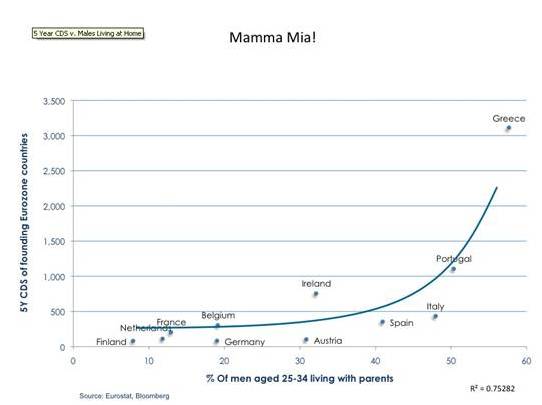
Courtesy of Eurostat and Bloomberg comes this chart correlating the current credit default swap spread for certain sovereign debt with the percentage of that particular country’s male population between the ages of 25 and 34 that lives with their parents.

Delayed Adulthood Caused by Economic Crisis


Initially, I struggled a little bit with how instructive this chart really is, wondering if there were other explanations for the high rate of mamma’s boys out there. For example, I think that it’s fair to say that the countries with the highest percentage of men at home is that they have strong familial traditions and it might not be unusual to have extended families living together. However, a recent visit with an authentic Greek friend of mine (first generation American with a home and regular travel back to the home country) indicates that the high number of home boys isn’t simply familial roots. Large numbers of Greeks are leaving their homes in the cities and returning to their more suburban or rural roots to ride out the economic troubles with their families. “There’s nothing left for them in the cities,” she said. Not to mention the brain drain that’s underway in these countries in which those that can find employment in other places are doing it and abandoning Greece altogether. The implications of these trends by themselves point to a generation of difficulties ahead for these countries, even if these were their only problems.


Crimes Against Nature and Traditionalism

February 5, 2012

Call me a traditionalist.

I don’t think anything goes into a bagel except dough and the occasional raisin. Especially chocolate chips. Ye Gods! Things can go on bagels, not in them. The list of things that I find “just fine the way they were and as God intended them to be” is longer than I care to go into here, but suffice to say that my traditionalism is the source of a certain degree of mockery and humor among my family, extended and immediate. One of my many sisters-in-law has likened me to the Grumpy Old Man character Dana Carvey played on Saturday Night Live many years ago. So be it.

Last week, I grabbed a piece of candy from the bowl established for that purpose in our office and snared one of my favorite treats, a Tootsie Pop. I walked away without looking at it, just putting it in my pocket for a late afternoon treat. And yes, I realize that there are few things more ridiculous looking than a middle-aged man sitting in his office with a lollipop in his mouth. I can accept that. My love for the Tootsie Pop makes me impervious to the criticism.

When the appointed hour for treats arrived, I retrieved the Tootsie Pop and was shocked, disappointed and confused.

A crime against nature. Artificially flavored with the "healthiest fruit" flavoring!

Pomegranate? What the hell is a Tootsie Pop doing with pomegranate flavoring?  It is only necessary for Tootsie Pops to come in four flavors: Cherry, Orange, Grape and Chocolate. That’s the way it has always been and the way God intended it to be. Amen.

Now, I understand that the pomegranate has become quite trendy and popular as a health food. I’ve seen it referred to as the ‘healthiest fruit”. My first encounter with pomegranate juice came when a guest at our house asked me for a vodka (or was it tequila?) with pomegranate juice; so probably not a healthy choice, but it was the start of a trend. This article talks of the identified benefits of eating pomegranates (anti-oxidants, lower LDL, etc.) and even details the ways to eat your pomegranates. Nowhere on this list of ways to eat your pomegranate does it mention getting your pomegranate intake from candy on a stick with a chocolate Tootsie Roll center!

And, of course, it’s not even “real” pomegranate flavoring. I’ll take my artificial flavorings the only way they should be offered: in artificial cherry, artificial orange, artificial grape and artificial chocolate, thank you very much.

Further investigation reveals that the fine folks at Tootsie Roll are making Pops with artificial green apple and artificial banana flavors, too. Oh, the humanity! Now I’ll have to closely investigate every time I grab one because the odds of coming up with some heretic flavor is much higher than I had previously calculated.

On those occasions when I buy jelly beans for the office candy dish, I attempt to buy the bag with the fewest black beans. Can’t stand ’em. Thankfully, the candy industry has begun to accommodate those of us with sophisticated palettes by selling bags without any black jelly beans in them right next to bags of exclusively black jelly beans. One of life’s little pleasures, to be sure. The Tootsie Pop people would be wise to take a page from this book and segregate their real artificial flavors from the trendy, kids-don’t-know-squat flavors.

Here endeth the rant.

(And, no, I don’t feel better now, because I got cheated out of my Tootsie Pop fix!)


Listen Up

January 25, 2012

Here’s a link to a cover of a song by The Civil Wars by my favorite artist.  Listen and enjoy.

A bonus track with video.

http://www.youtube.com/watch?v=mZ5pmTzJCzk&feature=g-all-u&context=G2fd2644FAAAAAAAABAA