Virginia’s Other Questions

December 3, 2011

On September, 21, 1897, the New York Sun newspaper ran what has become the most reprinted editorial of all time (reprinted below). It was in response to a letter written by eight year old Virginia O’Hanlon of Manhattan. She was looking for reassurance that Santa Claus existed and she turned to the Sun for that reassurance. (Can you imagine someone one hundred fifteen years later in our times turning to their local paper for reassurance on anything? Well, they could turn to The Local Paper!)

The story can now be told of what happened to little Virginia after she got her answer from the Sun.

Virginia had a wonderful Christmas that year, but as winter turned to spring she began to wonder about different things. A string of letters to the Sun and other publications followed over the course of the  years that followed, inquiring about other characters of lore, myth and fantasy. Characters she’d heard about but hadn’t seen in real life.  Characters like the Easter Bunny, the Tooth Fairy, Superman, Republicans willing to raise taxes, Televangelists not looking for money or self-aggrandizement, flamboyant accountants, and Baby Boomers willing to admit that the Beatles may not  in fact be the greatest thing since the invention of perforated toilet tissue.

As Virginia grew older, she realized that she’d been hoodwinked by the Sun and others to whom she’d turned for succor. It was inevitable that she became cynical and curmudgeonly. Instead of focusing on things that perhaps never were, she turned her attention to those things were once accepted as facts but had for various reasons had come into question as perhaps myths. Things like evolution, the willingness of college presidents to control their athletic programs, the ability for people to see a crime being committed, stop it and report it to the police, Hollywood’s ability to produce original material that isn’t based on washed-up television shows and that the United States Congress was actually the “World’s Greatest Deliberative Body”. She wondered whether the quarterback was in fact a football player or some porcelain doll, only to be looked at and admired from a distance. She looked for guidance on the ability of people to mow their own lawns and rake their own leaves, whether there was actually anything that government didn’t have an interest in trying to fix for us, and whether it was really possible that something bad could happen without it being someone else’s fault and actionable in court. No matter where she turned, no one had any answers. Just head shaking and shoulder shrugging.

So many questions, so few answers.

She considered whether there was ever a scorned or harassed woman who didn’t call Gloria Allred (or take Gloria’s call).  She tossed around the old notion that there actually isn’t news being created twenty-four hours a day and there used to be a time when people were left alone to actually do their jobs without being bombarded by the littlest thing turned into the “crisis of the moment.” Not paying the debts you signed up to incur used to be a bad thing, she was almost sure of it, but now the evidence was inconclusive and no one could tell her how that happened or why. She wondered if sportscasters were actually paid by the number of times they said the words “Brett Farve” [sic].  Acting like an idiot used to get you scorn; now it gets you a television contract and a book deal despite the fact that you can neither act, read or write.Virginia wondered how that happened. These were questions no newspaper could answer.

She couldn’t find anyone to help her with her recollection that candidates seeking to be President of the United States were once among the brightest and best people this country had to offer and not a band of deliberately ignorant, skirt-chasing boobs.

Finding no one to answer her more complicated adult questions about what to believe and what to believe in, she dreamt of those innocent days when thinking about the existence of Santa was as complicated as it got.

Yes, Virginia there is a Santa Claus, but even he would have trouble fixing what we’ve done to ourselves.

. . . . .

“DEAR EDITOR: I am 8 years old.
“Some of my little friends say there is no Santa Claus.
“Papa says, ‘If you see it in THE SUN it’s so.’
“Please tell me the truth; is there a Santa Claus?

“VIRGINIA O’HANLON.
“115 WEST NINETY-FIFTH STREET.”

VIRGINIA, your little friends are wrong. They have been affected by the skepticism of a skeptical age. They do not believe except [what] they see. They think that nothing can be which is not comprehensible by their little minds. All minds, Virginia, whether they be men’s or children’s, are little. In this great universe of ours man is a mere insect, an ant, in his intellect, as compared with the boundless world about him, as measured by the intelligence capable of grasping the whole of truth and knowledge.

Yes, VIRGINIA, there is a Santa Claus. He exists as certainly as love and generosity and devotion exist, and you know that they abound and give to your life its highest beauty and joy. Alas! how dreary would be the world if there were no Santa Claus. It would be as dreary as if there were no VIRGINIAS. There would be no childlike faith then, no poetry, no romance to make tolerable this existence. We should have no enjoyment, except in sense and sight. The eternal light with which childhood fills the world would be extinguished.

Not believe in Santa Claus! You might as well not believe in fairies! You might get your papa to hire men to watch in all the chimneys on Christmas Eve to catch Santa Claus, but even if they did not see Santa Claus coming down, what would that prove? Nobody sees Santa Claus, but that is no sign that there is no Santa Claus. The most real things in the world are those that neither children nor men can see. Did you ever see fairies dancing on the lawn? Of course not, but that’s no proof that they are not there. Nobody can conceive or imagine all the wonders there are unseen and unseeable in the world.

You may tear apart the baby’s rattle and see what makes the noise inside, but there is a veil covering the unseen world which not the strongest man, nor even the united strength of all the strongest men that ever lived, could tear apart. Only faith, fancy, poetry, love, romance, can push aside that curtain and view and picture the supernal beauty and glory beyond. Is it all real? Ah, VIRGINIA, in all this world there is nothing else real and abiding.

No Santa Claus! Thank God! he lives, and he lives forever. A thousand years from now, Virginia, nay, ten times ten thousand years from now, he will continue to make glad the heart of childhood.


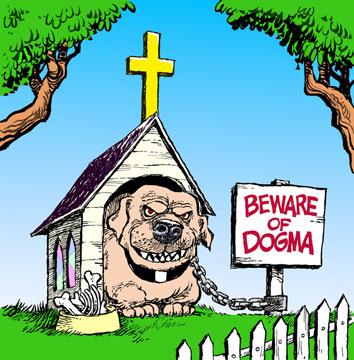
Thoughts on My Dogma

November 23, 2011

Have you met my boxer, Mohammad?

dog·ma

noun \ˈdȯg-mə, ˈdäg-\

plural dog·mas also dog·ma·ta
1 a : something held as an established opinion; especially : a definite authoritative tenet b : a code of such tenets <pedagogical dogma> c : a point of view or tenet put forth as authoritative without adequate grounds
2 : a doctrine or body of doctrines concerning faith or morals formally stated and authoritatively proclaimed by a church

My dogma:

  • has been neutered
  • doesn’t like cats
  • is in constant need of attention
  • loves to have its belly rubbed
  • enjoys being taken out to talk to the other dogmas in the neighborhood (and sniff their butts)
  • unconditionally loves me
  • sometimes destroys the things I love
  • has fleas
  • occasionally stinks
  • won’t hunt
  • is sometimes a bad dogma
  • is happy when I come home to it after having been away for a while
  • despises the garbage man
  • is only partially house-trained
  • is kept in a crate
  • and, of course, got run over by someone’s karma

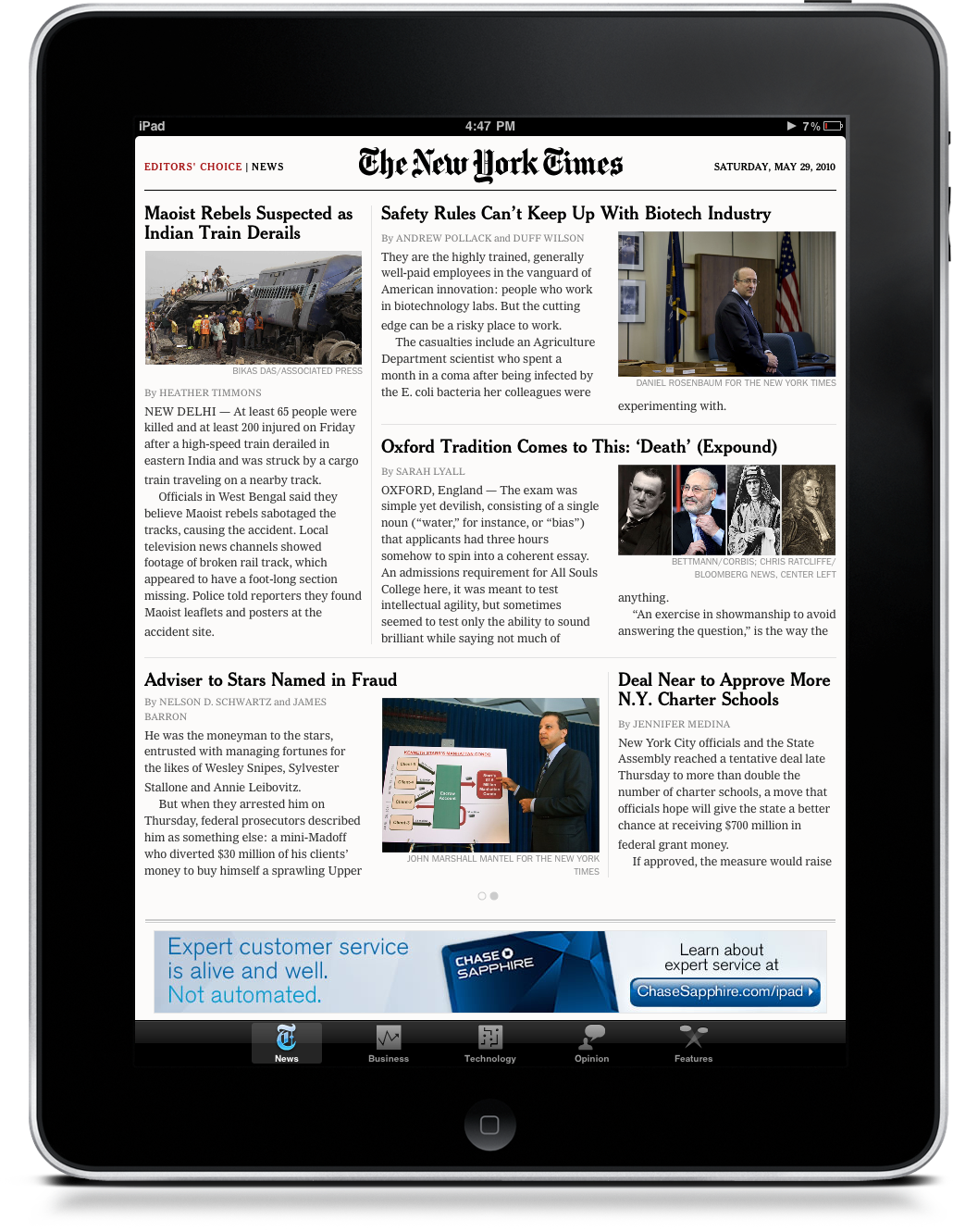
The New York Times iPad App Stinks

November 20, 2011

Duplicative, Disorganized and some other negative word beginning with D.

Oh how I hate their app.  Stories appear in multiple places.  Stories that are days old don’t go away. There’s no “stop”; no resting place.  It’s whatever is on Safari when you open the app.  And that stinks.  I want to read the day’s newspaper in an electronic form.  The Wall Street Journal’s app is perfect.  It gives you both that day’s printed paper in an electronic form and it uploads the website in a separate and distinct place, so that you can check what’s happening now (or the last time you accessed the app).

The reason that this is so important to me is best described by David Carr, the media writer for the Times (and star of the excellent documentary on the Times “Page One“)  in his recent interview with Terri Gross on Fresh Air.  Speaking of his media diet (which resembles mine so close a way as to be somewhat uncomfortable for me because he’s in the media criticism business and I am not), he said:

When I wake up in the morning and the gun goes off, I’m checking Twitter. I’m checking RSS feeds, and I get four newspapers at my house every day. I get the Wall Street Journal, the New York Post, the Star Ledger – because I live in New Jersey – and, of course, the New York Times.

And the reason I do is because the day before this, all this stuff has gone whizzing past me, and I seem to know a lot. But I don’t really know which part of it is important. And I used to think it was so silly that newspapers would – like, I’d go to our page one meeting, and they’d be organizing the hierarchy of the six or seven most important stories in Western civilization. Meanwhile, the Web is above them, pivoting and alighting, and all these stories are morphing and changing. And I thought: Well, how silly is this?

But you know what? I came to want that resting place, where someone yelled stop and decided, look, this is stuff you need to know about going forward. So there’s both real-time news and then newspapers have become a kind of magazine experience for me, where they’re – where it’s a way to look back at what has happened.

The Times app just gives me the “whizzing by” and not the stop, before you even get to my complaints about its (lack of) organization and repetition.


On Business Casual

November 17, 2011

I am exhausted by the dignity-stripping nature of “business casual” dress. It has turned us into slobs and released our inner schlubs. It needs to stop.

There.  I said it.  Someone had to.

As I type this, I’m sitting in first class on a flight from Boston to Chicago.  Next to me is a man in his late 30’s.  He’s dressed in an uninteresting French-cuff shirt with an open collar with British tan gabardine slacks and draw-string Ecco hiking shoes.  Across the aisle from him is a man in his early 50’s in “The Uniform”:  a blue oxford shirt, stone- or tan-colored chinos, black socks and unpolished slip-ons.  The loafers appear to be either Prada or knock-offs thereof.  Naturally, he has his “dork clip” on his hip; his Blackberry at the ready for the moment RIM’s servers choose to operate as advertised. (Editor’s comment:  no one ever got seriously laid while wearing a dork clip; nor explaining why they’re called “wing tips”.)  I have a colleague who wears nothing but The Uniform.  He professes to only own one white shirt.  He pouts and makes quite a fuss when the situation requires him to “dress up.”

There’s another guy a couple of rows back with a rumpled white dress shirt, untucked, under a black blazer with wrinkled, soiled khakis.  He’s old enough to know better, too.

For God’s sake, wash and iron your damn pants and tuck in your shirt!  Have you no pride?  You’re an educated professional, working in what is still the World’s Greatest Economy!  Millions of people around the country to say nothing of the rest of the world would give anything to be in your seat 3C, having your every food and beverage wish fulfilled.  Why do you insist on dressing the same way you did when your parents came to visit you in college?!

Whew.  I feel a bit better.  Oh wait.  There’s more:

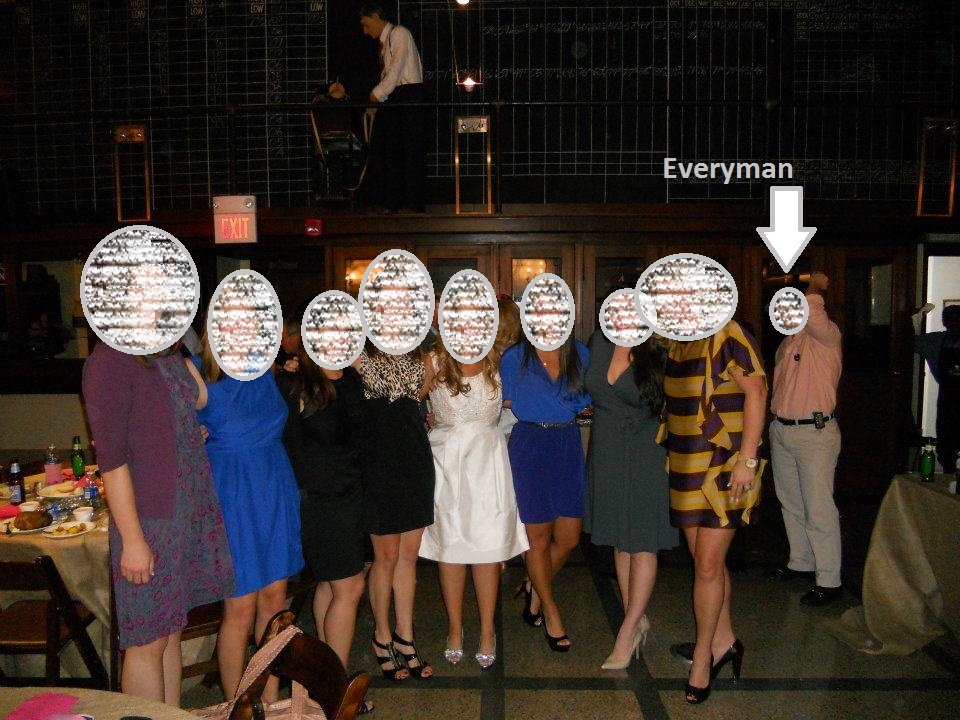
At least the Gucci loafers made it to the party.

How is it that women can manage to get dressed up for a night on the town and the best the guys can seem to muster is the now-ubiquitous untucked shirt with the sleeves rolled up and an old pair of jeans?  Or The Uniform–the same one they wear to work–or worse, the “dress t-shirt”? As they guys on ESPN say every Monday, “C’mon, man!”

And yes, I commit all of the sins noted above.  But at least I recognize them as sins.

P.S.  Hey Ladies:  FYI.  Leggings aren’t pants.

P.P.S.  Ok, I’ll make an exception just this once when the leggings are worn like this.


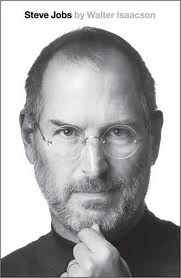
What Walter Isaacson Got Wrong About Steve Jobs

November 2, 2011

Hey Walter, were you even paying attention when we talked?

Walter Isaacson has done so much media in support of his biography of Steve Jobs that I feel like I’ve heard him read every part of the book except the ISBN and the chapter titles.  Everyone, probably even including Isaacson, wishes that the release of the book didn’t unhappily coincide with Jobs’ death, but it did and that adds extra poignancy to the work.  It didn’t hurt sales.

Some of the interviews with Isaacson have been better than others, of course and the quality of the interviewer usually dictates the quality of the interview.  This is what separates the dreadful  Ann Curry from Charlie Rose to cite just one egregious example.  Terry Gross of NPR and WHYY is one of the best in her field, at least in part owing to the fact that she has an hour to fill and can let her guest take time to develop and expand on their ideas.  Her guests really get to express themselves.

So I was surprised that after all these interviews and all this time with Jobs and thinking about his subject, Isaacson is wrong on an essential element of what made Jobs and Apple as successful.  Here’s Isaacson and Gross on the October 25th airing of Fresh Air:

GROSS: Now why did he want Apple to have its own operating system, one that would only run on Apple products?

ISAACSON: Jobs was an artist. It was like he didn’t want his beautiful software to run on somebody else’s junky hardware, or vice versa; for somebody else’s bad operating system to be running on his hardware. He felt that the end-to-end integration of hardware and software made for the best user experience. And that’s one of the divides of the digital age because Microsoft, for example, or Google’s Android, they license the operating system to a whole bunch of hardware makers.

But you don’t get that pristine user experience that Jobs as a perfectionist wanted if you don’t integrate the hardware, the software, the content, the devices, all into one seamless unit.

GROSS: So how did this work for and against Steve Jobs?

ISAACSON: It was not a great business model, at first, to insist that if you wanted the Apple operating system, you had to buy the Apple hardware and vice versa. And Microsoft, which licenses itself promiscuously to all sorts of hardware manufacturers, ends up with 90 to 95 percent of the operating system market, you know, by the beginning of 2000.

But in the long run, the end-to-end integration works very well for Apple and for Steve Jobs because it allows him to create devices that just work beautifully with the machines, for example the iPod, then the iPhone, then the iPad. They’re all seamlessly integrated. (emphasis added)

So in the year 2000, I think Microsoft probably had 10 times the market value of an Apple, but Apple surpassed Microsoft a year or so ago and is now the most valuable company on Earth by doing this integrated model. (emphasis added)

But that’s not right.  As James Surowiecki of The New Yorker points out in the October 17th issue of the magazine, it was ultimately Jobs’ willingness to allow others to use the platform and his precious products that made Apple the company that Isaacson recognizes as one that has transformed six and maybe seven industries and become the biggest market cap company in the world.  Apple left to itself was a 5% market share player.  Once it opened its platform, it was through the roof.  Sure it was partly because the products were great, but it doesn’t happen without the help of those outside Apple to make those products better.  Here is Surowiecki:

When Jobs returned [after having been fired], he still wanted Apple to, as he put it, “own and control the primary technology in everything we do.” But his obsession with control had been tempered: he was better, you might say, at playing with others, and this was crucial to the extraordinary success that Apple has enjoyed over the past decade. Take the iPod. The old Jobs might well have insisted that the iPod play only songs encoded in Apple’s favored digital format, the A.A.C. This would have allowed Apple to control the user experience, but it would also have limited the iPod market, since millions of people already had MP3s. So Apple made the iPod MP3-compatible. (Sony, by contrast, made its first digital music players compatible only with files in Sony’s proprietary format, and they bombed as a result.) Similarly, Jobs could have insisted, as he originally intended, that iPods and iTunes work only with Macs. But that would have cut the company off from the vast majority of computer users. So in 2002 Apple launched a Windows-compatible iPod, and sales skyrocketed soon afterward. And, while Apple’s designs are as distinctive as ever, the devices now rely less on proprietary hardware and more on standardized technologies.

The iPhone signalled a further loosening of the reins. Although Apple makes the phone and the operating system itself, and although every app is sold through the App Store, the system is far more open than the Mac ever was: there are more than four hundred thousand iPhone apps written by outside developers. Some are even designed by Apple’s competitors—you can read on the Kindle app instead of using iBooks—and many are so inelegant that Jobs must have hated them. Such apps make the iPhone messier than it would otherwise be, but they also make it much more valuable. The old Jobs might well have tried, in the interest of quality, to contain the number of apps: he always talked about how saying no to ideas was as important as saying yes. Though Apple does vet apps to some extent, the new Jobs essentially said, Let a thousand flowers bloom.

The introduction of the iPad has ratified this new reality, since developers have already released more than a hundred thousand apps for the tablet. The result is that the network effects that worked against Apple in the eighties, making it essentially a boutique company, are now working in its favor: the more apps Apple’s products have, the more people want to use them, which, in turn, makes developers want to develop for them, and so on.

Yes.  That makes perfect sense to me.  It’s a wonder that Isaacson missed it by such a wide margin.


Taxing The Rich; Two Views

October 24, 2011

Below are two letters to the editors of The Economist, reproduced in full from the 8 October 2011 issue.  While each comes at the tax question from different sides, I agree with both Sweeney and Shayer.  The ‘rich” have the lobbyists to make the tax code dance to their tune.  This is why the mortgage interest deduction will always be with us, among other giveaways to the middle and upper classes.

At the same time, it’s always been curious to me how charges of “class warfare” are always trump and unidirectional. It is always talk of increasing taxes that lead to this charge, rarely or never talk of increasing the burdens on those with lower incomes.  Is our denial of class differences that deep?  Yeah, we’re a “classless society” all right.  Any look at an income differential chart will show you otherwise.  Any discussion of where (or if) randomly selected kids are able to go to college will bear witness to the giant schism between the classes in America.   Being shocked, SHOCKED! at the use of “class warfare” simply works in the favor of the favored class.  It’s not a discussion people are comfortable having. Admitting to having classes, let alone having those classes “at war” is not what we aspire to, even though it’s very much where we are.

Read and ponder.


Taxing the rich

SIR – I believe I am classed as one of the wealthy in America, so I took a great interest in your leader on how to get the well-heeled to pay more tax (“Hunting the rich”, September 24th). You advocated a tax system that would make the top rates more equal on wages and capital, eliminate virtually all deductions and get rid of corporate taxes. This, you said, would allow for a much lower top rate of income tax and would actually reap more tax revenues from the rich. You appear to be arguing that I, as one of the rich, would prefer to see lower income-tax rates, and for this “benefit” would be willing to pay more money. What are you smoking?

I do not give a damn about tax rates. My entrepreneurial instincts are in no way discouraged by high marginal rates. But I do care about how much money I have to pay. I like my deductions, all perfectly legal, around which I have structured my life.

Yes, the tax system is unfair. The array of consumption and payroll taxes are regressive and result in the less well-off paying a higher proportion of their total income in taxes. And this will continue as long as we, the rich, can persuade the politicians who write tax laws, and who are also part of the monied class, to structure the tax system to indulge us.

What is there not to like?

Anthony Sweeney
Darien, Connecticut

SIR – Why is it called “class warfare” to advocate raising taxes on the rich, but not when it comes to cutting benefits to the poor?

David Shayer
Palo Alto, California


23 October 1962 – DEFCON 2

October 22, 2011

The Strategic Air Command (“SAC”) was the operational establishment in charge of America’s land-based strategic bomber aircraft and land-based intercontinental ballistic missile (ICBM) strategic nuclear arsenal from 1946 until it was disbanded in 1992.  SAC had operated at Defense Condition 3 (also known as “DEFCON”, this signals the level of military readiness) essentially since its inception.  DEFCON 3 roughly translates to something above “yawn”.   And so it was until the morning of 23 October 1962, when events led SAC Commander General Curtis “Bombs Away” LeMay to raise the level of readiness to DEFCON 2–roughly translated, “be ready for anything.” A good thing too, for on that day at St. Elizabeth Hospital in Dayton, Ohio was born one Marjorie Ann “Midge” Kuntz–someone for who personifies that “ready for anything” attitude and the love of my life. Her twenty-five years with me have proven that she operates well at DEFCON 2.

Any connection between the raising of the Defense Condition and the Cuban Missile Crisis is strictly coincidental.

Happy Birthday, Midge.

Mark…

P.S.  Bombs Away!

P.P.S.  LeMay’s other nickname was “Old Iron Pants”.  I’m taking huge credit for refraining from working that into this birthday tribute (such as it was) cum history lesson.


Something for the 99% to Protest

October 12, 2011

To: Wal-Mart From: The Durbin Amendment

I have sympathy and empathy for the 99% and some of their arguments.  The banking industry has done plenty of things that warrant scrutiny and correction, to put it mildly.  I am not a spokesperson or lackey for Bank of America, but…

I don’t understand why the 99%ers haven’t figured out that Wal-Mart’s lobbying prowess (and that of other retailers) is the reason that BofA is going to charge them $5 per month for their debit cards.  Under the Durbin Amendment to the Dodd–Frank Wall Street Reform and Consumer Protection Act, interchange fees (the fee paid by a retailer to process a debit card transaction) has been cut by about half.  Since someone has to pay for this elaborate and extensive (and efficient) electronic network that moves all this money, BofA and other banks pushed the charges onto the next logical customer–consumers who lack lobbying power.  What else would you expect the bank to do?  They’re not running a charity; they have shareholders to answer to.  Retail customers have less firepower than Wal-Mart and its cohorts, so Wal-Mart wins in front of Congress and retail bank customers lose.

Under the law, Wal-Mart’s fees paid to BofA and others falls by millions of dollars (the aggregate impact on banks processing debit card transactions is estimated at $14 billion per year!).  That’s money directly into the wallets of the retailers, who I’m sure are quietly sniggering in the background over this issue.  This is a direct transfer from the pockets of customers into the pockets of retailers, plain and simple.

And yet I see no protesters in front of Wal-Mart (whom I’m picking on here only because they’re the largest retailer and processor of debit card transactions–others gain as well).  No “Occupy Congress” movement.

I wish that the understanding of banking and how banks work was more sophisticated than what people picked up watching “It’s A Wonderful Life”.  A man can dream, can’t he?

Here’s an explanation of the Durbin Amendment from Wikipedia:

The “Durbin Amendment” is a provision in the final bill aimed at debit card interchange fees and increasing competition in payment processing. The provision was not in the House bill;it began as an amendment to the Senate bill from Dick Durbin and led to lobbying against it.The law applies to banks with over $10 billion in assets, and these banks would have to charge debit card interchange fees that are “reasonable and proportional to the actual cost” of processing the transaction. The bill aimed to restrict anti-competitive practices and encourage competition, and included provisions which allow retailers to refuse to use cards for small purchases and offer incentives for using cash or another type of card.

The Durbin Amendment also gave the Federal Reserve the power to regulate debit card interchange fees, and on December 16, 2010 the Fed proposed a maximum interchange fee of 12 cents per debit card transaction,which CardHub.com estimated would cost large banks $14 billion annually.On June 29, 2011, the Fed issued its final rule, which holds that the maximum interchange fee an issuer can receive from a single debit card transaction is 21 cents plus 5 basis points multiplied by the amount of the transaction.This rule also allows issuers to raise their interchange fees by as much as one cent if they implement certain fraud-prevention measures.An issuer eligible for this adjustment, could therefore receive an interchange fee of as much as 24 cents for the average debit card transaction (valued at $38),according to the Federal Reserve. This cap — which will take effect on October 1, 2011 rather than July 21, 2011 as was previously announced — will reduce fees roughly $9.4 billion annually, according to CardHub.com.As a result of the government limiting their revenue from interchange fees, banks made plans to raise account maintenance fees to compensate.


Five Minutes with A Smart Phone

September 26, 2011

Man carrying too many things, including his personal iPhone and his work blackberry inadvertently dials his wife’s cell phone.  It rings and he sees among the things that he’s carrying that he’s called her, but hangs up.  She’s at work, so he thinks she’ll never notice.  He initially thinks nothing of it.  Moments later, his phone rings.  Surprisingly, it’s his wife calling back.  Still with too many things in his hands to deal with the phone, he again inadvertently hits “ignore” and kills the call.

Less than a minute later, there’s a text message from her.  “Saw you called.  What’s up?”  Sigh.  Still messing with carrying more things than whole families bound for Ellis Island had onboard ship as well as rolling the trash cans away from the curb, he ignores it.

“She’s off work in thirty minutes,” he thinks.  “I’ll just talk to her when she gets home.”

Once he puts his burden down, and now with a minute to spare, he picks up the phone and calls again to try to clear up the confusion.  She’s working.  No answer.  He starts to type, “didn’t mean to…” but he never gets to finish.  The phone is ringing.  It’s her.

“You called?”

“Didn’t mean to.  Everything’s fine.”

Five minutes of back and forth over a mistakenly pushed button.  When you combine two people who care enough to make sure the other is alright and not in need of something with a few fat or just carelessly placed fingers, you’re left wondering if this is progress.


Pat Robertson on Alzheimer’s

September 17, 2011

Pat Robertson, always a lightning rod, stepped into a moral minefield last week when counseling a man on dealing with his spouse who has Alzheimer’s.

According to the New York Times:

On his television program, “The 700 Club,” on Tuesday, Mr. Robertson took a call from a man asking how he should advise a friend whose wife was deep into dementia and no longer recognized him.

“His wife as he knows her is gone,” the caller said, and the friend is “bitter at God for allowing his wife to be in that condition, and now he’s started seeing another woman.”

“This is a terribly hard thing,” Mr. Robertson said, clearly struggling to think his way through a wrenching situation. “I hate Alzheimer’s. It is one of the most awful things, because here’s the loved one — this is the woman or man that you have loved for 20, 30, 40 years, and suddenly that person is gone.”

“I know it sounds cruel,” he continued, “but if he’s going to do something, he should divorce her and start all over again, but to make sure she has custodial care, somebody looking after her.”

When Mr. Robertson’s co-anchor on the program wondered if that was consistent with marriage vows, Mr. Robertson noted the pledge of “till death do us part,” but added, “This is a kind of death.”

Much criticism has been leveled at Robertson, some of it by people who are inclined to disagree with anything that comes out of his mouth, no matter what it is.  I think that there are some who would argue that the world is flat if Robertson said it was round, despite the fact that they know better.

It’s fine to disagree with Robertson on this topic.  It’s clearly a tough and personal call.  But before you criticize, please watch Jan’s Story.  This link is the best teller of the tale.  The story aired on CBS Sunday Morning January 24, 2011.  It’s a revealing and touching tale of a couple in love and in the midst of the hell that is Alzheimer’s. A book followed and then this interview with Barry Petersen.  The Sunday Morning piece is better, but hearing Petersen discuss the feelings of their friends is also useful.

Petersen’s frank discussion about his feelings is useful in this discussion.  It’s a tough call.  But spend a few minutes in Barry Petersen’s shoes before criticizing Pat Robertson…or Barry Petersen.