This quotation is often attributed to former British Prime Minister Benjamin Disraeli, although the coinage is in doubt. Personally, my money is on Mark Twain. Not because of any particular knowledge but because it sure sounds like something he’d come up with.
In general, I’m in agreement with the assessment of the use of numerical analysis to bolster weak arguments. I’m in the business of making presentations and I can make a graph dance with data designed to show only the side I want you to see. I don’t mess with the data, only the way the data is depicted in the picture. It’s not remarkable, but you’d be surprised how many presenters don’t pay attention to the power of their pictures and how many audiences don’t realize they’re being manipulated.
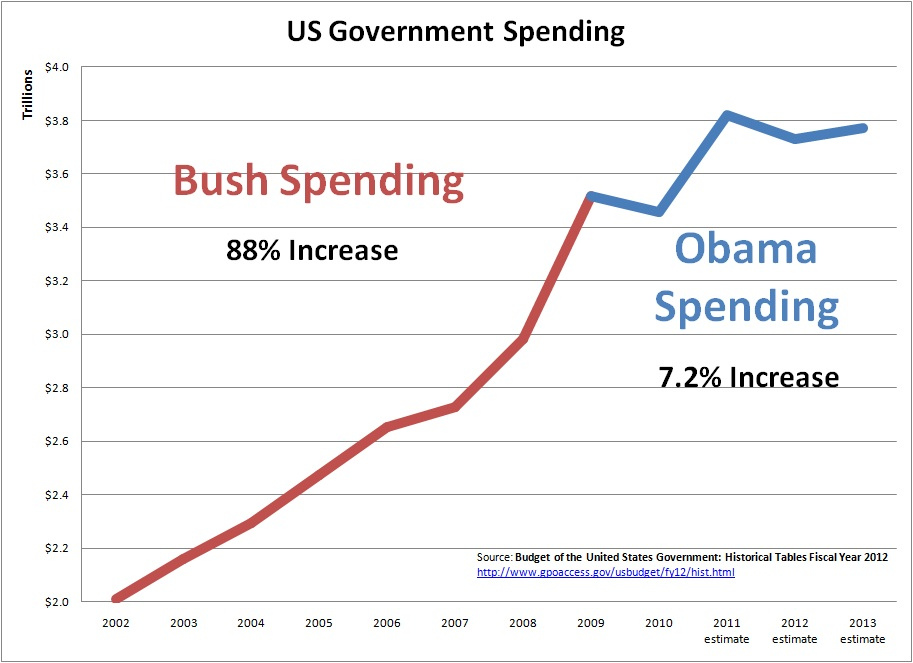
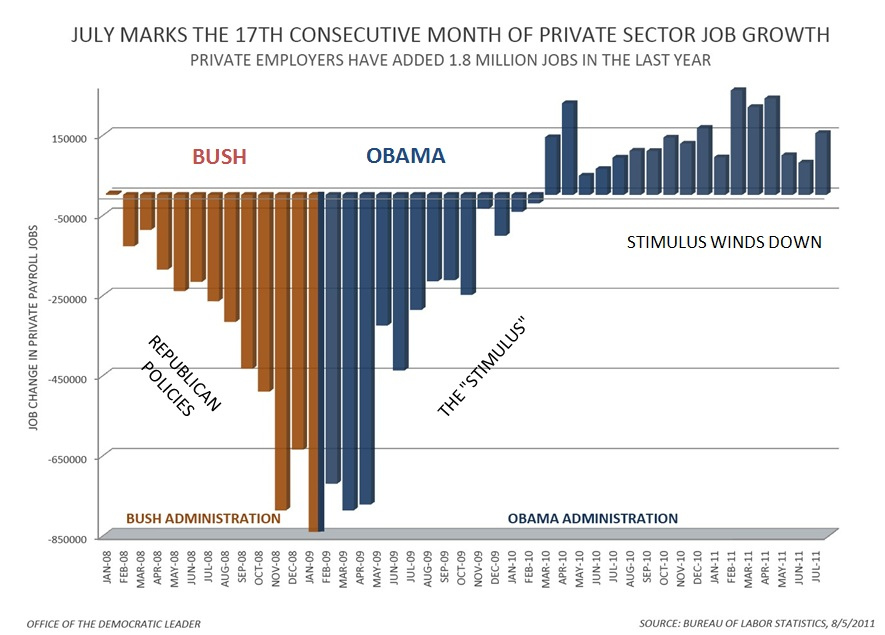
With that said, I present three charts that are making their way around the Internets now that we’re done with the Hurricane Hysteria (for now). The data in the charts is not complicated and therefore not subject to the kind of manipulation discussed above (that’s the way to tell if you’re being toyed with–ask yourself about the underlying complexity of the data. If it should be simple but appears complex, you’re being played). All three charts concern federal spending and the budget deficit. The data is sourced from the Budget of The United States and the Bureau of Labor Statistics. I have not independently sourced or verified the data.
The charts were originally produced here, and the author of that site is responsible for the captioning (of which I’m not necessarily a fan). Further, I think that the accuracy of the estimates for 2012 and 2013 should be highly discounted, given the dismal performance of the U.S. economy. I think it’s fair to say that the only way the numbers depicted become reality is with a rather substantial economic turnaround–one that has not made itself apparent at this point.
Recently, former Bush II speech-writer David Frum (author of the phrase “axis of evil” and other bell-ringers) wrote what I think is the most provocative and eye-opening couple sentences about the state of political discourse and economic thought and information on his blog, FrumForum.
So, in the interest of providing information that might run counter to your current thinking on the topic and with all the caveats noted above, here are the graphs.
It's a lot of money, but certainly not as big a change as some would like you to think it is.
More than a few people, many of whom I respect and are friends of mine have spent the day going out of their way to thank President Bush for his role in the kill/capture of Osama Bin Laden. Others say President Obama is “claiming credit” for what is really Bush’s accomplishment. This is fundamentally wrong and ignorant of the facts. Less than six months after an attack that killed nearly 3,000 people, the President of the United States announced that finding bin Laden didn’t matter.
QUESTION: Mr. President, in your speeches now, you rarely talk or mention Osama Bin Laden. Why is that? Also, can you can tell the American people if you have any more information — if you know if he is dead or alive. Deep in your heart, don’t you truly believe that until you find out if he is dead or alive, you won’t really want to make…
BUSH: Well, deep in my heart, I know the man’s on the run if he’s alive at all. And I — you know, who knows if he’s hiding in some cave or not? We hadn’t heard from him in a long time. . . So I don’t know where he is. Nor — you know, I just don’t spend that much time on him really, to be honest with you.
QUESTION: Do you believe the threat that Bin Laden posed won’t truly be eliminated until he is found either dead of alive?
BUSH: As I say, we hadn’t heard much from him. And I wouldn’t necessarily say he’s at the center of any command structure. And, you know, again, I don’t know where he is. I’ll repeat what I said: I truly am not that concerned about him.
[Updated 3-May *]. According to the New York Times, “By 2005, many inside the C.I.A. had reached the conclusion that the Bin Laden hunt had grown cold, and the agency’s top clandestine officer ordered an overhaul of the agency’s counterterrorism operations.” This included shuttering the CIA’s Bin Laden Issue Station unit tasked with tracking Bin Laden, headed by once coherent, now wack-a-doo Michael Scheuer. So POTUS declares him irrelevant and shuts down the unit with all the history and background. Instead of continuing the chase–a chase he might not win and didn’t control–President Bush elected to distract, dither, and divert resources to Iraq, tilting at windmills. However, the Times reports that along with the shuttering of BLIS, the Agency commenced “Operation Cannonball, a bureaucratic reshuffling that placed more C.I.A. case officers on the ground in Pakistan and Afghanistan.” The Times doesn’t say and I lack sufficient security clearance to know whether the initiation of Operation Cannonball was directed or even authorized by President Bush. In the spirit of magnanimity let’s say that he did. He permitted the scrapping of the old way of trying to catch Bin Laden and let the CIA start anew. Perhaps it was the putting of more agents in the field that helped lead to this week’s events. It’s not clear. [End update]
The Bush Administration’s 2002 declaration of irrelevance was a (failed) attempt to manage expectations and not have the view of its dual missions (Iraq and Afghanistan) tied to their ability to catch him. Having blown the chance to kill him at Tora Bora, the trail apparently went so cold that Andy Card and Karl Rove and the three amigos of national security team, Rummy, Cheney and Tenet thought they had no choice. Their focus was on avoiding being blamed for not getting him–in other words, managing the politics. They told us, “He’s in some of the remote mountains. We can’t find him. Regardless, he doesn’t matter. Now how about that Harriet Miers. Isn’t she something?”
(Let’s not start talking about the value of the information that came out of Guantanamo following our torture of prisoners. Based on their statements today, Liz Cheney and Bill Kristol should be asked: “If the torturing was so effective, why did we only get the courier’s nom de guerre?” Perhaps a 187th waterboarding session with KSM might have obtained it. But that’s an argument for another day.)
But we all saw last night, from coast to coast–college kids looking for a chance to gather, chant and sing the wrong words off-key notwithstanding–was a very clear statement that bin Laden was relevant. That it DID matter. It changed the status quo. It’s not clear by how much yet–maybe one degree, maybe 45 degrees. Time will tell, but cutting off the head of the snake matters.
Watching Black Hawk Down gives you some hint of what can go wrong in missions like these. Trying and failing is still failing. Ask Jimmy Carter. Obama risked a lot; from the lives of those incredible SEALS to his reputation. At some point in the early months of his presidency, Barack Obama told CIA chief Leon Panetta to make finding bin Laden a top priority. This is the opposite of irrelevant. Obama put the bullet in the chamber and order it fired.
Obama and his team tried where Bush and his team stopped trying. And for this, President Bush deserves our gratitude for his public service and devoting eight years to this country–but not thanks for helping get rid of Osama bin Laden.
* NOTE: The original version didn’t include references to Operation Cannonball. As noted, it’s not clear how much if any impact Cannonball had in getting to the desired outcome, but even if it did, the outpouring of gratitude for President Bush by his apologists and sycophants seems out of proportion.



 Posted by Mark Wegener
 The Local Paper