Four Years Ago

September 17, 2012

Starting with the Republican National Convention last month, there has been many people asking “Are you better off now than you were four years ago?”

And it got me to thinking about my situation and whether I am or am not better off.

  • Four years ago, the general public was blissfully and mercifully unaware of how very close our entire financial system came to bringing this country to its economic knees. (They still neither really know or appreciate the seriousness of the crisis, and as a result, efforts to reform the system and prevent future meltdowns has been largely ineffective.)
  • Four years ago this weekend, I was sending messages to my immediate family and to my in-laws telling them to go to the bank and get a couple thousand dollars in cash, because I was no longer confident about which of the nation’s banks would be able to open their doors on Monday, or if they’d bother to fill the ATMs with cash.
  • Four years ago, I was racing around moving money to banks that were likely to survive–those that I thought were too big for the government to let them fail.
  • Four years ago, I was on the verge of losing my job for what would turn out to be a 16-month period, as the financial system completely melted down and economic activity slowed dramatically.
  • Four years ago, the financial system failed. No one trusted anyone else. Intra-bank lending ceased. Markets were not functioning at all, let alone anywhere close to normal. It was a total collapse. We were staring into the abyss.
  • Four years ago, all the defanging of regulatory regimes and the hopes that market forces would correct all excesses without killing us came crashing down. Even our Randian Chairman of the Federal Reserve, Alan Greenspan, admitted that his long-held theories of market operations were proven incapable of explaining what happened, let alone preventing it. The markets corrected all right–all at once! when everyone ran from one side of the boat to the other, causing it to tip over.
  • Four years ago, it was every man for himself until the government and the Fed recognized the folly of letting the market work its unhindered magic.

I’ve now been re-employed by two separate firms in jobs that while perhaps not what I would ideally want to be doing, will suffice. The financial system is operational. Money is moving among the various players in the industry and between lenders and borrowers. The financial system has been saved. It’s far from perfect, and, as noted, some of the efforts to prevent future problems have been ineffective and off-base. But it’s working.

So, for me, the answer is most definitely YES. I am better off than I was four years ago. Whether we as a nation are better off is a slightly different question–but not one that the Romney camp is asking, yet.

The question that this line of argument from the Romney campaign raises is: Are they sure they really want to be asking this question? Most of the bullet points referenced above relate to the events of “Lehman Weekend” when Lehman Brothers was allowed to fail, Merrill Lynch was gobbled up by Bank of America, AIG failed, Fannie and Freddie were put into conservatorship, and all hell was breaking loose.

The anniversary of Lehman, et al. works against Romney, not for him. The non-regulatory framework, their undying belief in only-market forces that he advocates is precisely what led us down the path to the disaster that befell the financial industry. The excesses that built up were not effectively managed by the market.

Did the Romney campaign not have access to a calendar that showed September 2008? Did they not remember the headlines and front pages like this one?
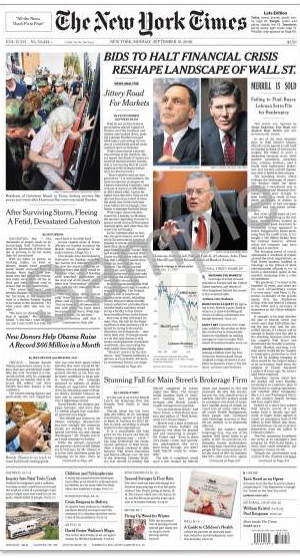
A Day to Remember. Why does the Romney campaign want to remind us of what was happening four years ago this weekend?

What are they thinking by pursuing this line of argument? Or are they thinking at all?


More on the Mortgage Crisis

September 26, 2010

Mo money, mo money, mo moneyThe following is my answer to a friend’s question about “what happened”, triggered the “this should have been a red flag” element of this article on the Huffington Post.

A confluence of events conspired to make this one worse than others (notice my restraint from calling this a “perfect storm”?).  What now appear to have been unnecessarily low interest rates by the Fed after the terror attacks meant investors were more hungry than usual for yield and sought investments that carried a higher return for what was perceived as equivalent risk.  Even though the return was higher on mortgage-backed bonds, the yield wasn’t nearly high enough for investors (insurance companies, pension funds, mutual funds, etc.) to do due diligence on thousands of mortgages buried within AAA-rated securities.

It was a risk/reward calculation for investors.  The investors were working with their coverage teams at I-Banks (a process called “reverse inquiry”).  The I-Banks worked to create securities that met the return and risk criteria set out by the investors–because that’s what they do, they sell bonds and get (well) paid to do so. They, in turn, need product to package so they first buy as much of it as they can from third parties, then, over time, buy their own mortgage companies to originate as many mortgages as possible (a pure vertical integration strategy–capturing the means of production).  Borrowers had low interest rates and plenty of mortgage money to be had were willing participants.  Lenders, having a ready source of cash (the sale of the loans to I-Banks and investors), and eager borrowers, used other people’s money to churn volume.  And this is just the “cash market”, which says nothing about the “synthetic market” in which a short side of the trade was required before anything could even get started (see Magnatar, Goldman, etc.)

Everyone was looking for something and managed to get it, largely by looking the other way and willfully suspending their disbelief.  As is common in these cycles, people who are long the asset always think that they’ll be smart enough to get out before it crashes.  But only some do because once you hop on the profit escalator, it’s tough to jump off when others continue to make what look like profits.  Once everyone is on one side of the ship, it’s gonna tip over.  As people realize that it’s tipping to the starboard side, they start, slowly at first and then en masse to race to the port side, which causes the ship to tip over in THAT direction instead.  It’s the herd mentality that people have written about for hundreds of years.  (One of th best efforts on this topic is Mackray’s “Extraordinary Popular Delusions and the Madness of Crowds” written in the mid-1800s).  In short, it was ever thus.

I did about a 45 minutes blow-by-blow presentation on this to some grad students a while back.  If I can figure out how to post the PowerPoint slides the germane pieces of it (perhaps a video blog post?).

Having never been a fan of the repeal of Glass-Steagall, I honestly don’t think that it’s repeal was much of a factor in this.  Remember that G-S separated commercial from investment banking.  Lehman and Bear and Goldman and Morgan Stanley weren’t commercial banks, so everything they did would have still been done (at 33x leverage).   That said, Citi and BofA were underwriters of bonds and also commercial banks that failed so keeping the wall up arguably would have helped them.  But there’s also the case of the Royal Bank of Scotland–the biggest bank failure of all time.  It wasn’t their underwriting of bonds that got them in trouble, but what they bought that got them into trouble.  There was an element of this in the failure of BofA and Citi, too, so it’s hard to say.

It’s true, there will be a “next time”.  The troubling thing is the observation that the boom/bust cycles are coming both closer together and becoming more violent.  Until meaningful regulations are put (back) into place (and the recently passed regs don’t strike me as such), and investors, underwriters and issuers get serious about risk management we’re likely in for it again.  Never underestimate the imagination and power of people whose interest is in figuring out how to do thinks not prohibited by regulations.  The securitization business has had its epitaph written several times in the last twelve years (think Enron and off-balance sheet issues), only to find new life thanks to creative lawyers, accountants and bankers.