Joke of the Day

September 16, 2011

News item:  UBS announces loss of $2 billion from a “rogue trader” making unauthorized trades.

From Stephen Colbert:  “Swiss financial giant UBS reports a $2 billion loss from rogue trades, and while that sounds like a lot, it’s only a fraction the $17 billion they lost through authorized trades.”


Brother Ray Loves America

September 11, 2011

It’s a song that elementary school children learn (at least we used to learn it–who knows what happens now) and people reflexively sing often without thinking about the lyrics.  As was typical of his music, Ray Charles offered an interpretation of the song that was and is piercing and beautiful.  On par with the power and majesty of Handel’s Hallelujah Chorus, I can’t listen to this without getting chills, particularly the end. “Oh Lord.  I thank you lord.”


The Answer is “No” or “Not Yet”.

September 6, 2011

April 21, 2011:  Texas Governor James Richard “Rick” Perry issues a proclamation declaring the three-day period from April 22 through April 25 “Days of Prayer for Rain in Texas”.  (People suffering drought in Oklahoma and elsewhere are told to get their own governors to pray for them.)

August 6, 2011:  Governor Perry holds “The Response”, a prayer rally that draws 30,000 people in Houston, Texas.

Perry Prays for Rain


September 5, 2011:  God responds.

Bad messenger?


Thought for the Day

September 5, 2011

Here’s one of my favorite songs.  It has several  of my favorite couplets, including one that has special meaning for me today.  Written by John Prine and performed best by Bonnie Raitt (follow this link to hear my favorite version of the song, performed by both Raitt and Prine at a benefit concert for Steve Goodman; pardon the advertising).   Here’s a version of Raitt performing it as a solo.

It’s one of those songs that I never skip when it comes on; one that I always really listen to, and one that often induces chills. I hope you enjoy it.

http://www.youtube.com/watch?v=vhe3vb0z7mY

I am an old woman named after my mother
My old man is another child that’s grown old
If dreams were lightning thunder was desire
This old house would have burnt down a long time ago

Make me an angel that flies from Montgomery
Make me a poster of an old rodeo
Just give me one thing that I can hold on to
To believe in this livin’ is just a hard way to go

When I was a young girl I had me a cowboy
It wasn’t much to look at, was a free ramblin’ man
That was a long time and no matter how I tried
The years they just rolled by like a broken down dance

Make me an angel that flies from Montgomery
Make me a poster of an old rodeo
Just give me one thing that I can hold on to
To believe in this livin’ is just a hard way to go

There’s flies in the kitchen, I can hear them there buzzin’
And I ain’t done nothing since i woke up today
How the hell can a person go on to work in the morning
And come home in the evening and have nothing to say?

Make me an angel that flies from Montgomery
Make me a poster of an old rodeo
Just give me one thing that I can hold on to
To believe in this livin’ is just a hard way to go


Interesting Pictures (If You Like This Sort of Thing)

August 28, 2011

“There are three kinds of lies.  “Lies, damned lies and statistics.”

This quotation is often attributed to former British Prime Minister Benjamin Disraeli, although the coinage is in doubt. Personally, my money is on Mark Twain.  Not because of any particular knowledge but because it sure sounds like something he’d come up with.

In general, I’m in agreement with the assessment of the use of numerical analysis to bolster weak arguments.  I’m in the business of making presentations and I can make a graph dance with data designed to show only the side I want you to see.  I don’t mess with the data, only the way the data is depicted in the picture.  It’s not remarkable, but you’d be surprised how many presenters don’t pay attention to the power of their pictures and how many audiences don’t realize they’re being manipulated.

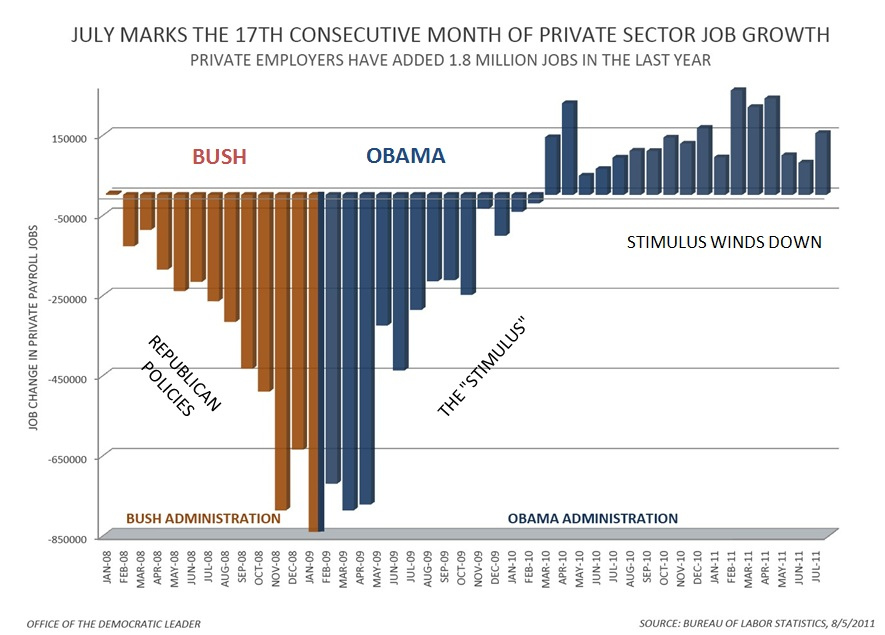
With that said, I present three charts that are making their way around the Internets now that we’re done with the Hurricane Hysteria (for now).  The data in the charts is not complicated and therefore not subject to the kind of manipulation discussed above (that’s the way to tell if you’re being toyed with–ask yourself about the underlying complexity of the data.  If it should be simple but appears complex, you’re being played).  All three charts concern federal spending and the budget deficit.  The data is sourced from the Budget of The United States and the Bureau of Labor Statistics.  I have not independently sourced or verified the data.

The charts were originally produced here, and the author of that site is responsible for the captioning (of which I’m not necessarily a fan).  Further, I think that the accuracy of the estimates for 2012 and 2013 should be highly discounted, given the dismal performance of the U.S. economy.  I think it’s fair to say that the only way the numbers depicted become reality is with a rather substantial economic turnaround–one that has not made itself apparent at this point.

Recently, former Bush II speech-writer David Frum (author of the phrase “axis of evil” and other bell-ringers) wrote what I think is the most provocative and eye-opening couple sentences about the state of political discourse and economic thought and information on his blog, FrumForum.

Imagine, if you will, someone who read only the Wall Street Journal editorial page between 2000 and 2011, and someone in the same period who read only the collected columns of Paul Krugman. Which reader would have been better informed about the realities of the current economic crisis? The answer, I think, should give us pause. Can it be that our enemies were right?

So, in the interest of providing information that might run counter to your current thinking on the topic and with all the caveats noted above, here are the graphs.

It's a lot of money, but certainly not as big a change as some would like you to think it is.

Not information you'll get from watching CNBC.

Share


The Ohio State University and its Credibility Problem

August 19, 2011

From ESPN.com’s Tuesday Morning Quarterback column from this week comes a must-read for college football fans.  (Emphasis added):

O-H! N-O!

Ohio State’s Jim Tressel and Terrelle Pryor, cleared by the NCAA for the Sugar Bowl, later were forced to resign (Tressel) and suspended (Pryor) for violations the NCAA knew about prior to the Sugar Bowl. BCS games are among the biggest revenue events in collegiate athletics, so the NCAA waited until the money was in the bank.

Tressel admitted he was warned that OSU players were breaking NCAA rules, but said he did nothing because he “couldn’t think of who” to report this to. Ohio State has a six-person NCAA compliance office. It took me 45 seconds to get the names and phone numbers. Surely the associate athletic director for compliance sits within walking distance of Tressel’s office. With a straight face, Tressel claimed he didn’t know whom to tell about a compliance issue.

After the scandal broke, Ohio State announced it was voluntarily “vacating” all 2010 football victories. Yet open the new 2011 Buckeyes football media guide and the games are listed as wins.

As for OSU President Gordon Gee…[he] seemed to stand for the school’s integrity when he announced Tressel had resigned and would be fined $250,000. Later, Gee quietly changed Tressel’s resignation to a retirement, qualifying him for taxpayer-subsidized state benefits, waived the fine, and awarded Tressel about $50,000 in severance. So when the president of OSU makes a public announcement, he may or may not be telling the truth. That’s some example Ohio State is setting.

Defending the program as Tressel departed, Gee wrote, “Ohio State’s football team ranked first in academic performance among the nation’s top 25 teams.” Melinda Church of Gee’s office told me he was citing this NCAA Public Recognition Award: under Sport, click “Football FBS,” then “Display All.” But the award is not for “academic performance.” The award is for improvement as measured by the NCAA’s Academic Progress Rate  [the “APR”] — that is, for raising a previous score. Gee changed academic “progress” to academic “performance.” Misrepresenting the content of a cited source is a big sin in academia — but apparently doesn’t bother the president of Ohio State….

The NCAA for its part is poised to make the APR system somewhat less lax — but only to the extent that colleges must graduate 50 percent of their athletes in order to qualify for football bowl games and basketball tournaments. That the NCAA’s ambitious goal is 50 percent graduation of athletes tells you how deeply fouled up the situation is.


The Discarded Student-Athlete

August 19, 2011

It’s common to read and hear the chattering classes on ESPN and other places talk about college athletes being used by their institutions to make big bucks while the “student-athlete” is left with nothing to show for his labors.  Frequently, the athlete can’t afford to live away from home and resorts to activities that violate NCAA rules just to get by while on campus (see the Ohio State football mess; also the allegations against the University of Miami).  University presidents and athletic directors routinely say they did the athletes a favor by offering them an education.  But many of those athletes couldn’t readily access that education either because they lacked the academic heft to have been admitted to the school without their athletic prowess or they simply lacked the interest in being educated–they’re only there for their sport and the chance to make it to the professional level.  All this does the athlete a great disservice, not to mention that it sullies the schools, too, but that’s for another time.

It’s less common to hear of athletes getting chewed up and spit out at the high school level.  But it happens.  Here’s one story.  Fair Warning:  The story has been related to me second-hand.  I have not personally spoken to the family or the young man involved.  That said, I am confident enough in the sources to share the tale here.

A young man from a family we know through mutual friends was a stand-out high school athlete on a team that would perennially contend for state championships.

Sadly, the young man faced challenges.  He abused alcohol and drugs throughout his high school career.  The athletic department knew this.  His coaches knew this. His parents knew this.  Despite professing “zero tolerance” for violations of the substance use policy, the young man was allowed to continue to participate; to continue to contribute to the team’s goals and to position himself for a major college scholarship.

Verily, the scholarship offers arrived from schools with great academic and athletic reputations.  He picked one early in his senior year and was ready to go.  He participated in events all through his senior year while continuing to have run-ins with the administration about his consumption.  But he never lost his spot on the team.

It was a great senior season.  The team did well.  The young man contributed to a state championship. Records were broken; celebrations were had.

Following the conclusion of the season, there was another incident.  Then and only then did the school take action against the young man.  They kicked him off the team.  After they had used up his skills and time and overlooked his problems long enough to hang another banner from the rafters, they were done with him.  It cost him his scholarship.  Even though he did nothing differently than had been previously tolerated during the season, they took an action that his prospective college couldn’t abide and he lost his ride.

I am in no way excusing the young man’s behavior.  He knew the rules and apparently violated them repeatedly.  Had the coaching staff followed their own procedures–you know, the ones that they use on the kids that aren’t stars on the team, where they kick the kid off so fast it makes your head spin–perhaps the young man could have better addressed his issues.  He would not have been so successful and the team might have suffered, but a chance at intervention would not have been missed.

In college, this happens quite often.  It’s referred to as a “money in the bank” approach to violations and punishment.  This is how the NCAA dealt with Reggie Bush at USC and later with the Ohio State problems.  Investigations were said to be underway, but no one was disputing the principal facts.  The players and coaches involved were cleared by the NCAA to play in their respective bowl games and generate giant television revenues for the NCAA and its member schools.  Only after the money is in the bank does the punishment come down.

The cynicism of the school and athletic administration in how they dealt with this young man is shocking and infuriating.  The school and the coaches used this young man just as surely as college athletes are used and discarded by their institutions.  But this is high school.  High.  School.  When they were finished with him, they spit him out and left him and his family to deal with an even bigger wreck than their might have been had they acted when they first confronted the problem.

I’m afraid to ask what happened next.


The Dinner Party from Hell

August 2, 2011

At some point, we’ve all been subjected to the parlor game, “Fantasy Dinner Party”.  You go around the table and name one person, living or dead, that you’d want to have over for a meal.  There are predictable results.  Jesus, the President (whomever that might be at the time), Churchill, Lincoln, someone’s great grandpa who died in a farm accident, The Dalia Lama, John Lennon, George Clooney, and on from there.

On the other hand, we’ve all had those experiences in which you’re seated with a bunch of duds, suddenly responsible for either carrying the entire dinner conversation or diverting it from some train wreck that another guest has initiated.  Listening to someone drone on about how well they treat their nanny and how much she just loves their kids or the differences in fuel efficiency between the Gulfstream g650 and the Lear 85, I find myself considering whether the butter knife is actually sharp enough to product a fatal, self-inflicted wound.  It’s also led me to consider The Dinner Party from Hell–people you would hate to have to share a meal with for whatever reason.

My ground rules are pretty simple:  Hitler, Stalin, Pol Pot, and their ilk are not eligible–they’re too easy.  Anyone else is fair game, living or dead.  As you’ll see, I have a wide variety of people on my list.  While I include politicians, it’s not necessarily because I disagree with their policies or their politics. I just find them either annoying to listen to or generally uninteresting.  I’ll listen to anybody that has an interesting viewpoint–even if it’s one I disagree with.

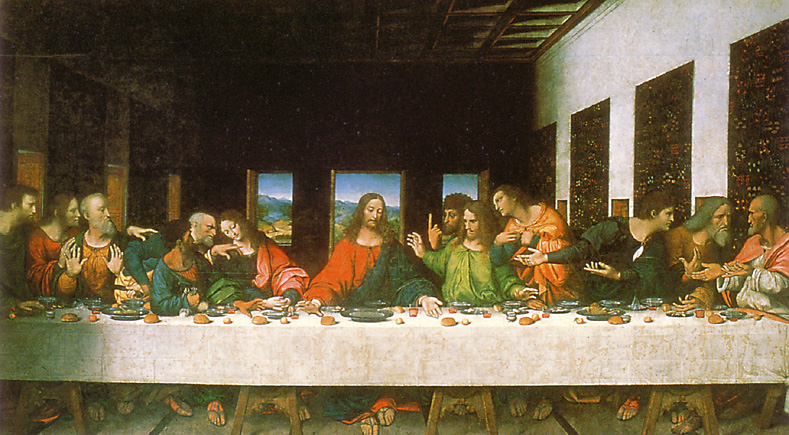
The Original Dinner from Hell?

It’s interesting to consider that Jesus was probably at the original dinner from hell.  I mean, really.  One of your buddies turns you into the cops and you get the death penalty after a sham trial.  One of your other buddies denies that he knows you on three separate occasions within a twelve-hour period.  Not to mention that everybody else scattered then hid at the point at which you coulda used a few friends.  On top of that, the meal consisted of bitter herbs–how tasty could that have been?  But to be fair, Jesus didn’t help himself out much.  The discussion of what he wanted to happen after he was gone, with all the instructions and note-taking (I’m sure he didn’t give out PowerPoint slides), sorta put a damper on the whole evening right from the get-go.  In short, not an enjoyable meal.

The common thread to those on my list (which continues to be a work in process) is that the mention of their name or the sound of their voice sends me into a convulsion to either change the subject or find the clicker and change the channel as quickly as possible.

Here’s my current (non-exhaustive) list:

  • Chris Matthews.  Stop screaming.  Not interested.
  • Either Winklevoss. Grow up. Move on.  Do something with your lives other than try to mooch off of that dork, Zuckerberg.
  • Eric Cantor.  Usually I’m a sucker for a Virginia accent, but Representative Cantor’s “smarm/snide” quotient exceeds my limit.
  • Joel Osteen or the lovely Mrs. Osteen (he said with gritted teeth), she of the “do you know who I am” flight attendant encounter.
  • Civil War re-enactors (well, any re-enactors for that matter)
  • Gayle King, Oprah’s most famous hanger-on as a proxy for hangers-on everywhere
  • Jim “Mad Money” Cramer.  “Bear Stearns is not going bankrupt.”  No more need be said.
  • Maxine Waters
  • Andy Roddick as a proxy for all athletes who are singularly focused and singularly uninteresting (as opposed to say, James Blake).  (Although if Andy were to bring Brooklyn, I might figure out how to make an exception).
  • The voice-over guy on the Jos. A. Bank commercials that tells me if I buy one pair of socks, I get everything else in the store that fits me for free.  That’s the reason I can’t shop at Joe Bank.  My closets aren’t big enough for all the free stuff.  Nothing says “quality” like giving your clothes away.
  • Angelina Jolie.  In general, self-aggrandizers need not apply.  I’m just not interested in her seeming desire to adopt one child from each country of the world.
  • Extreme Wine/Food snobs.  I enjoy a nice glass of wine and a nice meal as much as anyone, but I don’t need to be told about the silt concentration of the loam in which the grapes were born.  Neither am I interested in each and every ingredient of a meal someone had three months ago (or how that meal was “cooked to perfection”) that I wasn’t there to eat!
  • The dinner will feature authentic English or Scottish cuisine.  I guess when you live on an island, you make do with what you have, but that still doesn’t excuse cooking the food until it is completely devoid of flavor.
  • Entertainment at my Dinner from Hell will be provided by the otherwise lovely Jennifer Hudson, singing that damn song from the Weight Watchers advertisement. Egad.  I’m glad you feel gooooooooood, but your driving me bats!

Honorable Mention Guests from Hell:

  • Any cast member from Jersey Shore, or frankly anyone who has so fully taken leave of their senses to let themselves to appear on a reality television show.  In my vast reading of the entertainment press, I did see and hereby acknowledge that someone named Heidi Montag and her boyfriend Spenser Pratt (Spenser is on the List from Hell for being named “Spenser”) admitted that, “you can be too famous“.  Good work, kids.  Now undo all that surgery and live your lives.  Go forth and sin no more.
  • Will Smith as proxy for famous parents of famous kids who don’t realize that their kids are really only famous because they have a famous parent and that they’re really not all that talented.  They just had access to the industry and its experts and were given a chance as a result of the fame in the family (see also that douche bag, Jason Reitman).
  • Bono.  Love the music but, dude, honestly, shut up.
  • Kim Jong Il.  I hear he loves golf and repeatedly tells the story of his 11 holes-in-one the first time he ever played and his other amazing feats.  Pass.
  • The Other Winklevoss.

I could go on forever.  Who’s on your list?


Get Rid of The Debt Ceiling – Update

July 27, 2011

Nothing is more gratifying than when someone who you think is smart agrees with your position–even if that person has no idea who you are let alone what position they’re agreeing with you on.

Earlier this week, I suggested that the U.S. should get rid of the debt ceiling as a legislative concept.

Now comes the August 1 edition of The New Yorker in which financial columnist James Surowiecki advocates the same position, albeit using more words and better arguments than I was willing to spend time making.

The truth is that the United States doesn’t need, and shouldn’t have, a debt ceiling. Every other democratic country, with the exception of Denmark, does fine without one. There’s no debt limit in the Constitution. And, if Congress really wants to hold down government debt, it already has a way to do so that doesn’t risk economic chaos—namely, the annual budgeting process. The only reason we need to lift the debt ceiling, after all, is to pay for spending that Congress has already authorized. If the debt ceiling isn’t raised, we’ll face an absurd scenario in which Congress will have ordered the President to execute two laws that are flatly at odds with each other. If he obeys the debt ceiling, he cannot spend the money that Congress has told him to spend, which is why most government functions will be shut down. Yet if he spends the money as Congress has authorized him to he’ll end up violating the debt ceiling.

. . .

We may nonetheless end up with a halfway sensible budget deal. But that would be the result of luck, not design. Instead of figuring out ways to raise the debt ceiling, we should simply go ahead and abolish it. The U.S. economy has plenty of real problems to deal with. We shouldn’t have to wrestle with ones we’ve created for ourselves. 

I couldn’t have said it better myself.


Policy Changes Under Two Presidents

July 25, 2011

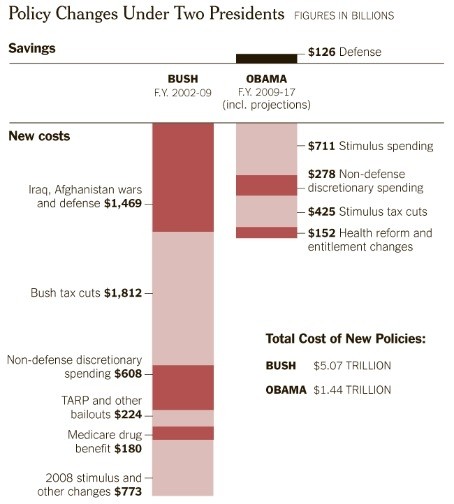
Republicans get defensive when comparisons are made between President Obama and President Bush.  That is understandable.  The chart below appeared in yesterday’s New York Times, accompanied by an article entitled “How the Deficit Got This Big” by Teresa Trich.  Ezra Klein today points out today that much of what appears on President Obama’s side of the ledger represent temporary expenditures (g., e.the $711 billion of “stimulus spending” and the $425 billion of “stimulus tax cuts”) where as the largest items on President Bush’s side of the ledger (and what at least 2o sitting GOP senators and 100 GOP House members voted for) represent recurring expenditures (e.g., the wars, the Bush tax cuts, the Medicare Part D drug benefit which will go on in perpetuity).

Klein notes, “To relate this specifically to the debt-ceiling debate, we’re not raising the debt ceiling because of the new policies passed in the past two years. We’re raising the debt ceiling because of the accumulated effect of policies passed in recent decades, many of them under Republicans. It’s convenient for whichever side isn’t in power, or wasn’t recently in power, to blame the debt ceiling on the other party. But it isn’t true.”

Sad, especially given the behavior of the GOP during the debt ceiling crisis, but true.